When you first search for “Soapland” in Tokyo, the areas that immediately come to mind are probably Yoshiwara, Shinjuku Kabukicho, Ikebukuro, and Uguisudani.
Interestingly, as these areas have developed over the years, their nature and characteristics have gradually taken on distinct forms. To briefly summarize:
Yoshiwara is arguably Tokyo’s most iconic soapland district, boasting the highest concentration of establishments; while Shinjuku and Ikebukuro do have adult entertainment venues, they are more akin to large-scale entertainment districts; Uguisudani, on the other hand, is better known for its hotel district and “delivery health” (デリヘル) services, and its location near Ueno makes it highly accessible for both domestic and international travelers.
Japanese authorities define Soapland as Category 1 under “store-based special adult entertainment businesses,” which refers to businesses that provide contact-based services using bath facilities and private rooms. This is distinct from general store-based adult entertainment, outcall services, and nightclubs. Thanks to Japan’s unique Soapland culture, it has become a destination for men from around the world who love nightlife, making it
Overview of Tokyo’s Major Soapland Districts
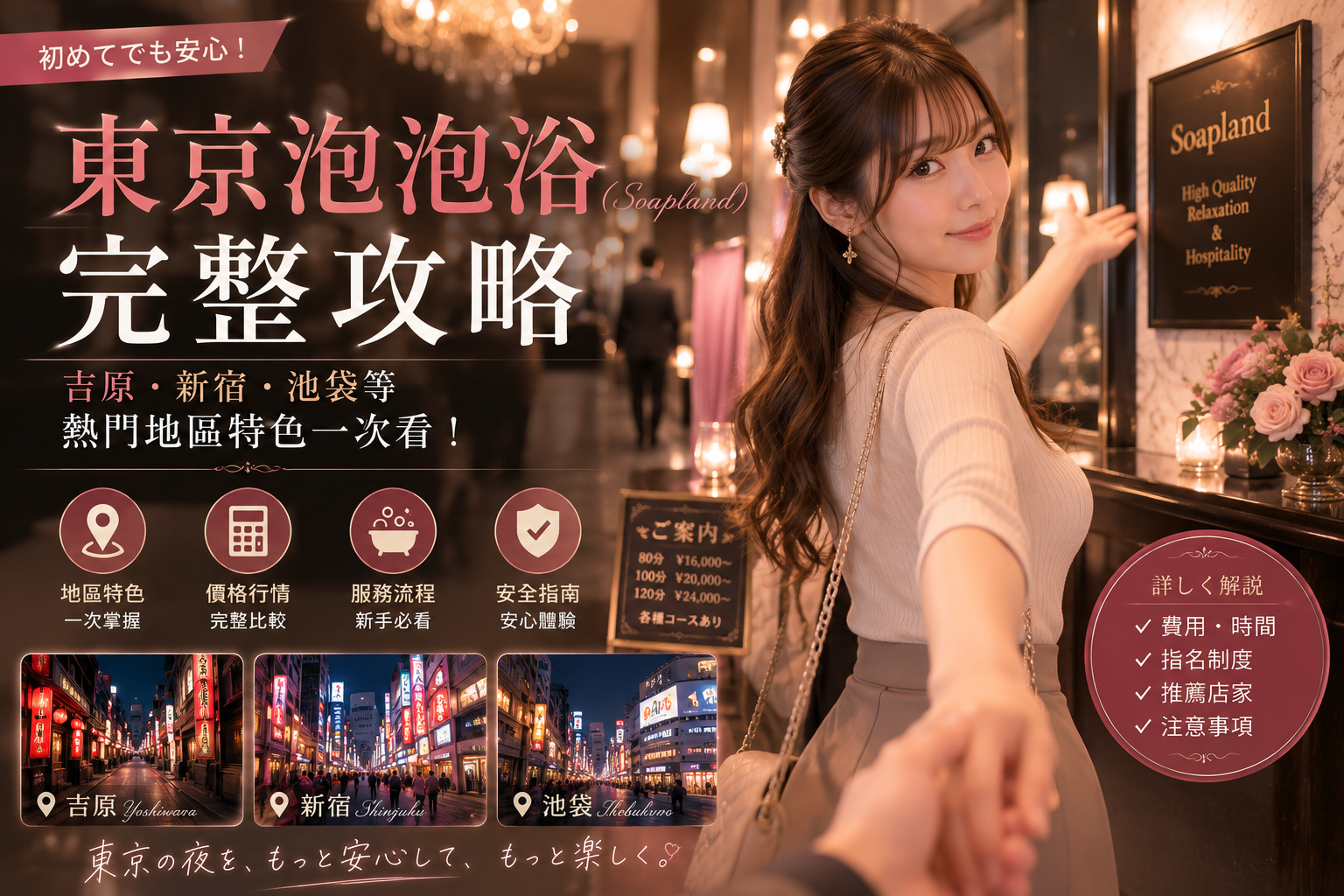
When it comes to Tokyo’s adult entertainment districts, locations frequently mentioned by travelers include:
・Yoshiwara, Shinjuku Kabukichō, the areas around Ikebukuro North Exit and West Exit, Uguisudani, and the areas around Ueno
① Yoshiwara
Tokyo’s most iconic and oldest birthplace of Soapland culture, it is also currently the most concentrated area, featuring a high density of establishments and the widest range of price points and service options.
② Shinjuku
A well-known, diverse nightlife district in Tokyo, it’s not just about Soapland—this area is also famous for its high concentration of various types of bars, host clubs, talking bars, clubs, nightclubs, and all kinds of adult entertainment. Although it doesn’t have as many Soapland establishments or as wide a selection as Yoshiwara, the sheer variety of adult-oriented entertainment makes it highly recommended for travelers to explore and experience.
③ Ikebukuro
Ikebukuro is an area with excellent transportation, shopping, and daily amenities. By day, it’s bustling with shopping malls and pedestrians, but at night, the North and West Exits come alive with neon lights, and the signs of adult entertainment establishments light up one after another.Although its overall scale and concentration don’t quite match those of Yoshiwara, the area has seen significant growth recently. It’s important to note that many of these establishments are not run by Japanese owners; travelers hoping to experience authentic Japanese service are advised to do their research and check reviews carefully!
④ Uguisudani
Known for its hotel district, convenient station access, and proximity to Ueno. While this area is often included in discussions of Tokyo’s nightlife, Uguisudani primarily focuses on outcall services. I won’t go into detail here today—I’ll cover it thoroughly in a future article on the “outcall tea” culture.If you have a generous budget and want to experience authentic culture, Yoshiwara remains the most highly recommended and representative area; if you’re simply looking to explore Tokyo’s nightlife and broaden your horizons, Shinjuku and Ikebukuro are better choices due to their convenience and diversity.
An In-Depth Look at the Most Iconic District: “Yoshiwara”
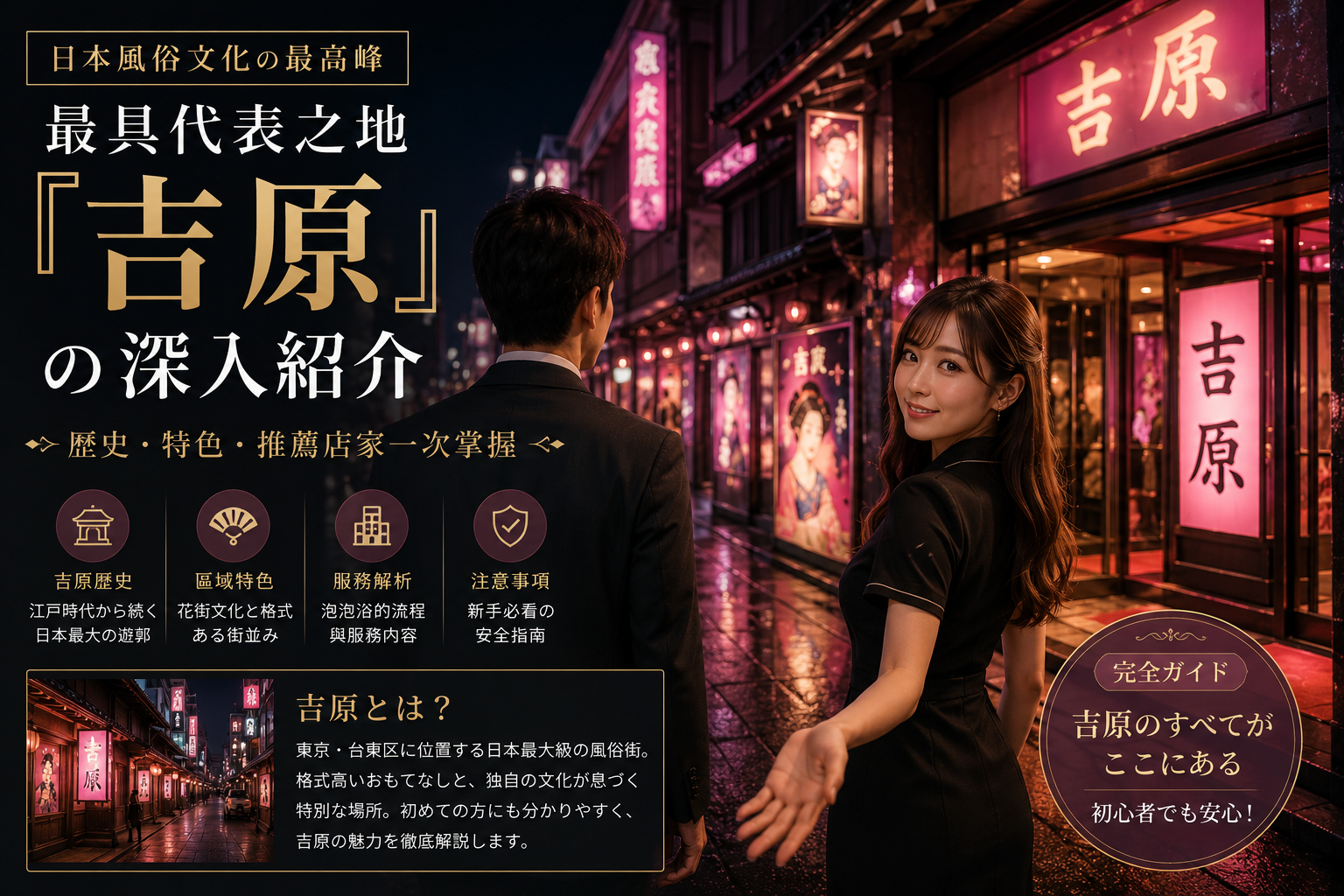
Why is Yoshiwara the most representative area with the highest concentration of establishments?To answer that, we must start with its history and culture. During the Edo period, Yoshiwara became an officially designated “yūkaku district”—that is, a red-light district specifically set aside by the government.
Although the neighborhood’s modern regulations, architecture, and business models have undergone numerous changes and updates, the historical legacy of “Yoshiwara” has kept patrons coming back, and it has gradually evolved into today’s famous Soapland district.
What is commonly referred to today as the Yoshiwara Soapland District is primarily concentrated around Senzoku 3-chome and 4-chome in Taito Ward; it is not the name of a modern administrative district officially designated as “Yoshiwara.”Some on-site surveys have estimated that there are currently over 100 establishments in the area, with an estimated workforce of more than 1,000 service staff. Given these numbers, you’re sure to find Girls and a service here that will make your heart flutter 😍😍😍 Note
:Since establishments are constantly opening, closing, and adjusting their staff, the actual numbers are subject to change; these figures are for reference only.
💗 Yoshiwara’s biggest feature: an enormous selection
There are countless establishments in Yoshiwara, offering a wide range of options to suit every preference:
・Budget-friendly establishments with accessible prices. Available ✅・Mid-range establishments (mid-level shops) that emphasize
ambiance and overall balance. Available ✅・High-end establishments (high-class shops) that operate
by appointment and prioritize privacy and hospitality. Available ✅・Establishments specializing
in specific age groups, images, or styles. Available ✅
While the wide variety of choices is a major advantage, it also means there’s a lot of information to process. It’s easy to get overwhelmed when researching for the first time, so start by using third-party websites that list establishments open to foreign customers and display photos of the Girls and their unique features—this will save you time and effort!
💗The Atmosphere of the Yoshiwara District
I wonder what image comes to mind when you think of red-light districts or Yoshiwara?
Even frequent travelers to Japan may find this area a bit unfamiliar at first, as it’s a relatively quiet, purpose-driven neighborhood that’s part commercial, part residential. Although some streets are densely packed with soaplands, before the neon lights come on at night, there’s a sense of tranquility that makes you wonder if you should actually walk in.
Since most establishments here operate on an appointment-only basis, it’s not recommended to linger outside the doors for long periods, take photos of the shops, or photograph passersby unless you have a prior reservation or a specific purpose. This isn’t just a matter of courtesy—it also involves the privacy of the staff, customers, and nearby residents, and you may be met with disapproving glances or even reprimands.
💗Who is Yoshiwara best suited for?
It’s best suited for:
・Those who, since they’re coming to Soapland, want to experience the most classic services and the area itself. ・Regulars who want to focus
on the experience rather than sightseeing or the hustle and bustle. ・Those
who have made a reservation in advance and received the shop’s information.
・Travelers staying in Ueno, Asakusa, or the eastern part of Tokyo.
Less suitable for:
・People who have absolutely no intention of doing any research beforehand. ・People
who just want to hop off the train and
pick a place at random. ・People who are very concerned about the “touristy” vibe and convenience near the station.
Note: As a foreign traveler, it’s recommended that you make a reservation before heading to any district—this way, you’ll have a safer and more enjoyable experience!
Introduction to Tokyo’s Largest Entertainment District: “Shinjuku (Kabukichō)”
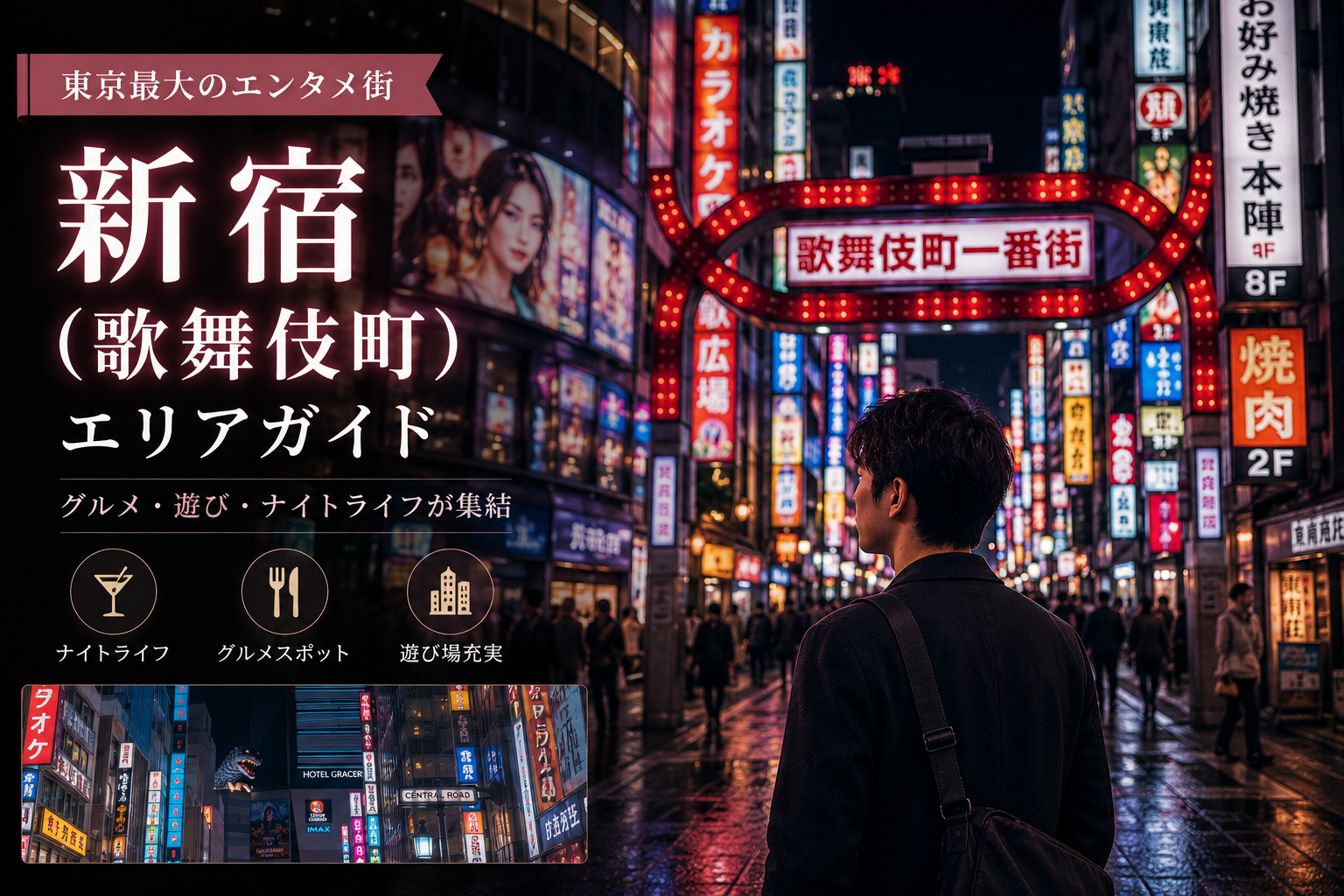 Kabukichō is located east of Shinjuku Station. It’s home to a huge concentration of restaurants, izakayas, bars, clubs, host clubs, karaoke venues, movie theaters, and adult entertainment establishments. Even if you don’t plan to experience the adult entertainment scene, simply window-shopping, sampling the local cuisine, and wandering into a bar to drink until dawn is a favorite itinerary for many night owls. But if you’re reading this article, you’re surely looking for more than just this superficial form of enjoyment, right?! Here’s a direct look at the Soapland culture in Shinjuku—which differs from that of Yoshiwara 👇👇
💛 Shinjuku’s biggest advantage: Easy to plan your itinerary and get around
Shinjuku Station is one of Tokyo’s most important transportation hubs, so guests staying here don’t need to worry about getting back from daytime sightseeing spots—many train lines will take you right back to Shinjuku.
If you want to save your energy for the evening’s experiences, we also recommend staying at a hotel in Shinjuku. During the day, you can visit Shibuya, Harajuku, and attractions in western Tokyo, then return to Kabukichō at night for dinner or entertainment—all without wasting too much time or energy traveling between districts.
However, keep in mind that Shinjuku Station is very large. If you have your venue information in advance, you can use a map app on your phone to plan a route that’s convenient and ensures you won’t be late for your evening reservations.
💛What should first-time visitors to Shinjuku be aware of?
Kabukichō is such a vibrant area that it attracts not only foreign tourists but also many local Japanese residents. As a result, you’ll often encounter people soliciting business, free information booths, or staff offering impromptu recommendations who approach you on the street.
A helpful tip from Fu-ZoKlook: Whether or not you speak Japanese, be careful not to get carried away by the excitement and follow a stranger into an establishment. If you haven’t confirmed the price, the shop’s name, and the services offered in advance, you may easily end up with a mismatch between your expectations and reality.
A safer approach is to first sign up for a “helper” service that assists foreign travelers with booking adult entertainment establishments in Japan, then head directly to your pre-booked venue.
💛 Who is Shinjuku best suited for?
It’s best suited for:
・First-time independent travelers to
Tokyo ・Those staying in or near Shinjuku
・Those who want to combine nightlife, dining,
and shopping ・Those who don’t want to make a special trip to eastern Tokyo
However, if your sole purpose is to explore a wide variety of soaplands, I’d still recommend heading to Yoshiwara.
Introducing “Ikebukuro,” Where Anime, Department Stores, and Nightlife Coexist
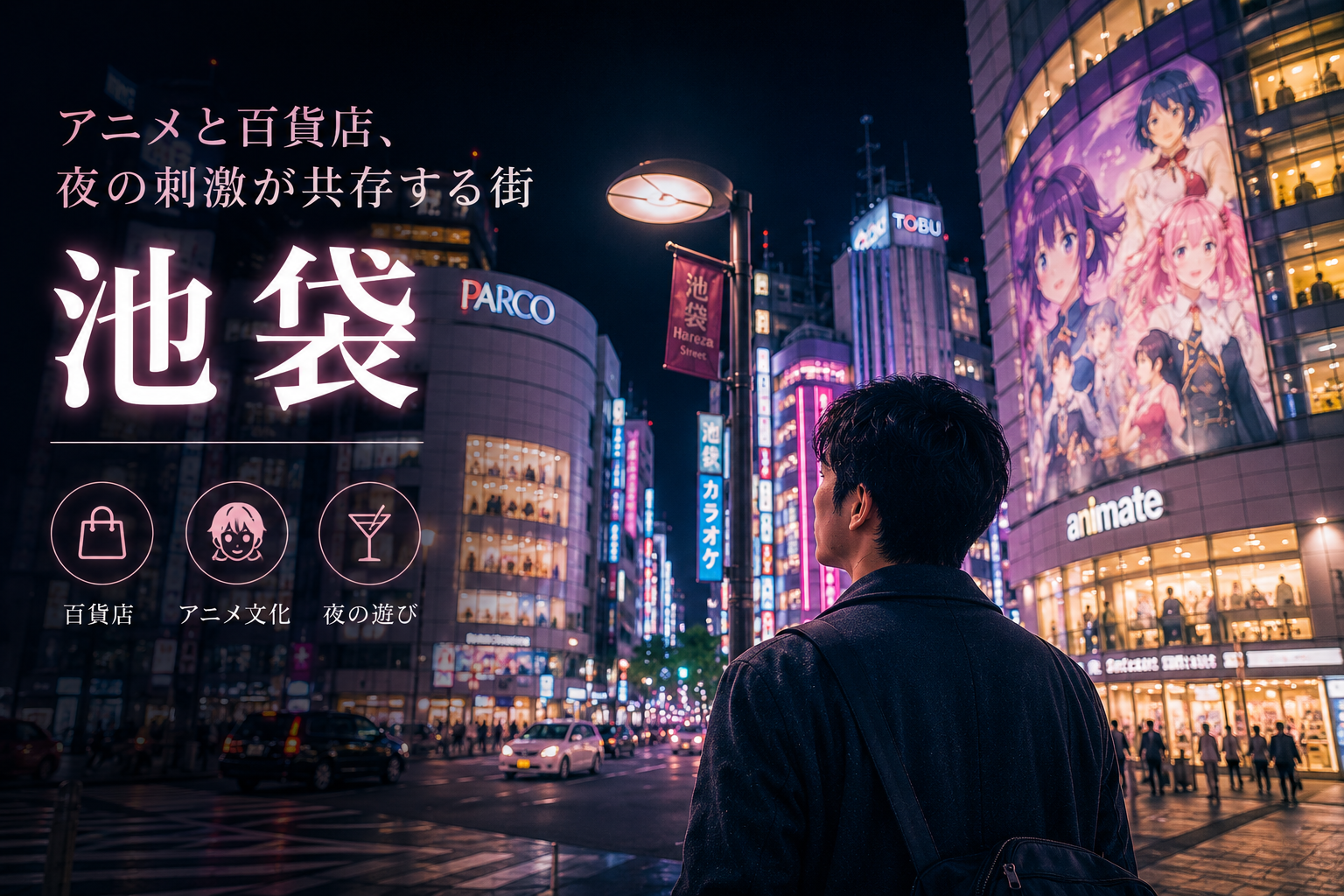
Ikebukuro is a major transportation and commercial hub in northern Tokyo.
The JR Yamanote Line, Saikyo Line, Shonan-Shinjuku Line, and several Tokyo Metro lines all pass through Ikebukuro. During the day, you’ll find department stores, anime shops, an aquarium, and a wide variety of restaurants; at night, entertainment venues are concentrated around the North and West Exits.
Another notable feature of Ikebukuro is that in recent years, it has gradually become a hub for many Chinese, Korean, and Indian residents living long-term in Japan. As a result, the Soapland parlors and adult entertainment establishments here are quite willing to accommodate foreigners at more affordable prices. However, a significant proportion of the staff are also foreign nationals. If you’d prefer to be served by a Japanese girl, it’s safer to double-check with the establishments in this area beforehand.
🩵 Ikebukuro’s Biggest Feature: Comprehensive Amenities
Ikebukuro is ideal for planning a full day’s itinerary centered around Ikebukuro Station.
For example, during the day, you can explore the East and West Exits of Ikebukuro Station:
・Anime and character goods stores ・Shopping
at
department stores ・Cafés and restaurants
・Indoor attractions
Then, in the evening, head back to the North Exit for nighttime entertainment.
🩵The Distinctive Character of Ikebukuro’s Neighborhoods—Such a Big Difference Just One Exit Away
The atmospheres at Ikebukuro’s East, West, and North Exits are very different.
The East Exit is more focused on department stores, shopping, and anime tourism; the North and West Exit areas, on the other hand, have more izakayas, hotels, and adult entertainment venues.
So here’s a quick tip: if you’re spending most of your daytime at the East Exit, keep in mind that even if a venue you book for the evening is listed as “Ikebukuro,” its actual location might be quite far away and require a significant walk.
So, after making a reservation, be sure to confirm:
・Which exit the venue is near ・The official
name of the venue ・The address
・Whether
you need to go to a designated location first to make contact
Ikebukuro Station is huge, and taking the wrong exit could add over ten or even twenty minutes to your travel time!
Introductions to Other Popular Areas: Uguisudani, Ueno, and the Tokyo Suburbs
There are several other areas in and around Tokyo that are frequently visited by adult entertainment enthusiasts. We’ve compiled a brief overview of these areas for you here.
💜 Uguisudani
Uguisudani is located along the JR Yamanote Line and Keihin-Tohoku Line, just one stop away from Ueno.
This area is known for its hotel district and a more low-key nightlife atmosphere. Most services are delivered via outcall.
Some people mistakenly believe that Yoshiwara and Uguisudani are the same area, but they are actually different. Yoshiwara is located northeast of Uguisudani, and you’ll need to take a bus or taxi to reach it. While some visitors take a taxi from Uguisudani or Ueno to Yoshiwara, this does not mean the two areas are part of the same neighborhood or offer the same types of services.
Uguisudani is best suited for:
・Those staying near Ueno ・Those familiar
with Tokyo’s nightlife ・Those looking
for discreet
, short-distance nighttime services ・Those who have already made a reservation
💜 Ueno
Ueno itself isn’t a hub for Soapland, but it serves as a very convenient transportation hub for getting to Yoshiwara. Ueno also has many delicious and affordable restaurants and izakayas, so we highly recommend stopping by to fill your stomach before or after your visit.
Why should you get to know Ueno before heading to Yoshiwara? Because it offers:
・Major JR lines
・Keisei Ueno Station
・Transportation to Narita Airport
・A wide variety of hotels and restaurants
・Taxi and bus options
Therefore, if you’re planning your first trip to Yoshiwara, consider staying in Ueno to make your journey convenient and enjoyable. When it’s time for your appointment, simply transfer from Ueno via subway, taxi, or other transportation options to reach your destination.
💜 Kawasaki
Kawasaki is located in Kanagawa Prefecture and is not part of Tokyo proper, but because it’s not far from Shinagawa and downtown Tokyo, it’s often included in guides to nightlife and Soapland spots in the Greater Tokyo Area.
The Horinouchi and Minamimachi areas of Kawasaki have long been known as adult entertainment districts. For travelers staying in Shinagawa, Kamata, or near Haneda Airport, Kawasaki is sometimes more convenient than Yoshiwara.
Recommended for guests who have already visited Yoshiwara and want to explore Soapland in other areas.
Comparison of Soapland Prices Across Tokyo’s Districts
Currently, there are no clear statistics on “average prices in Yoshiwara, Shinjuku, and Ikebukuro,” and prices can vary even within the same area.
In addition, prices are often influenced by the following factors:
・Session duration
・Establishment’s positioning
・Use of discounts
・Request for a specific attendant ・Exclusive
rates for specific attendants
・Weekdays, weekends, or special dates ・Whether website
prices include all fees ・Differences between credit card
and cash payments
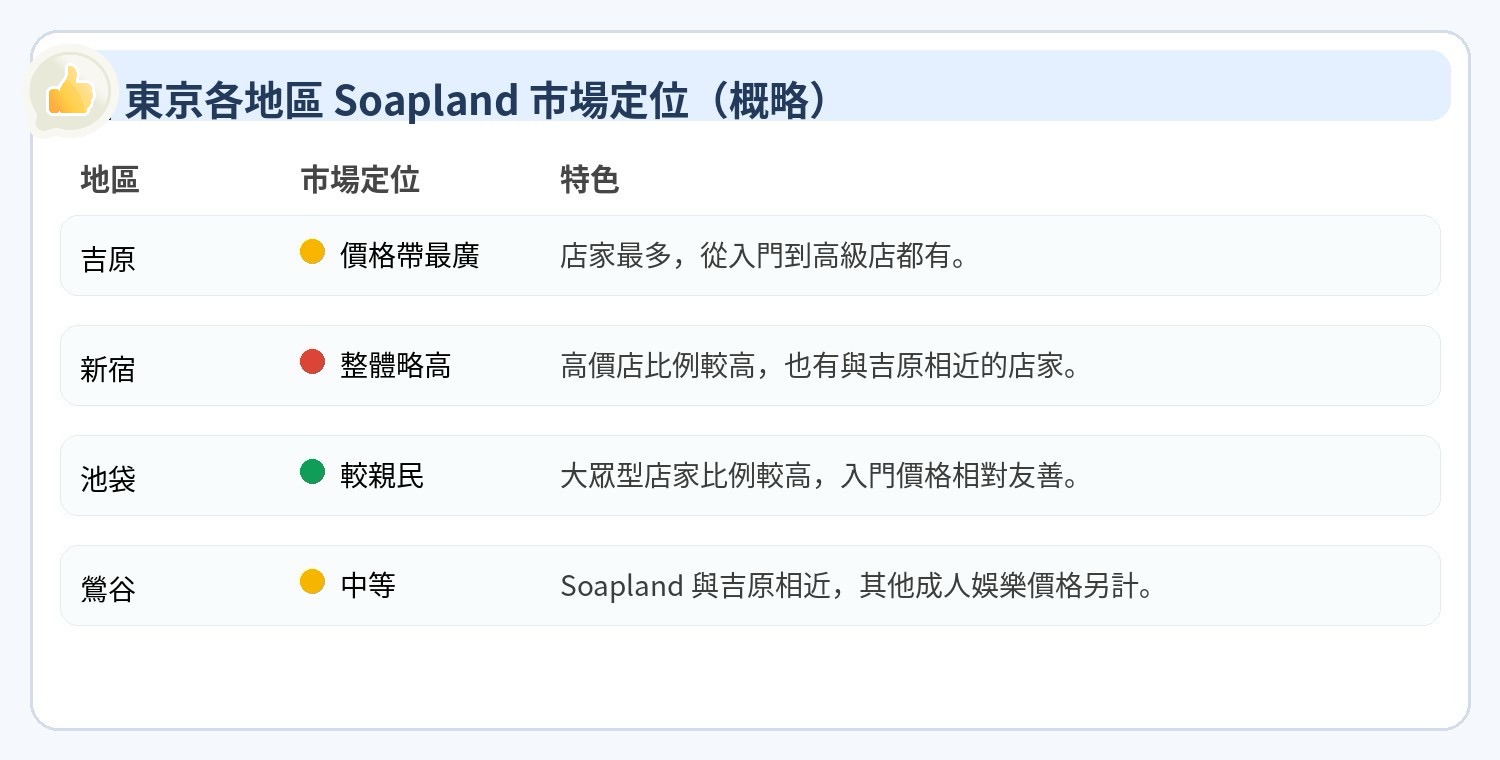
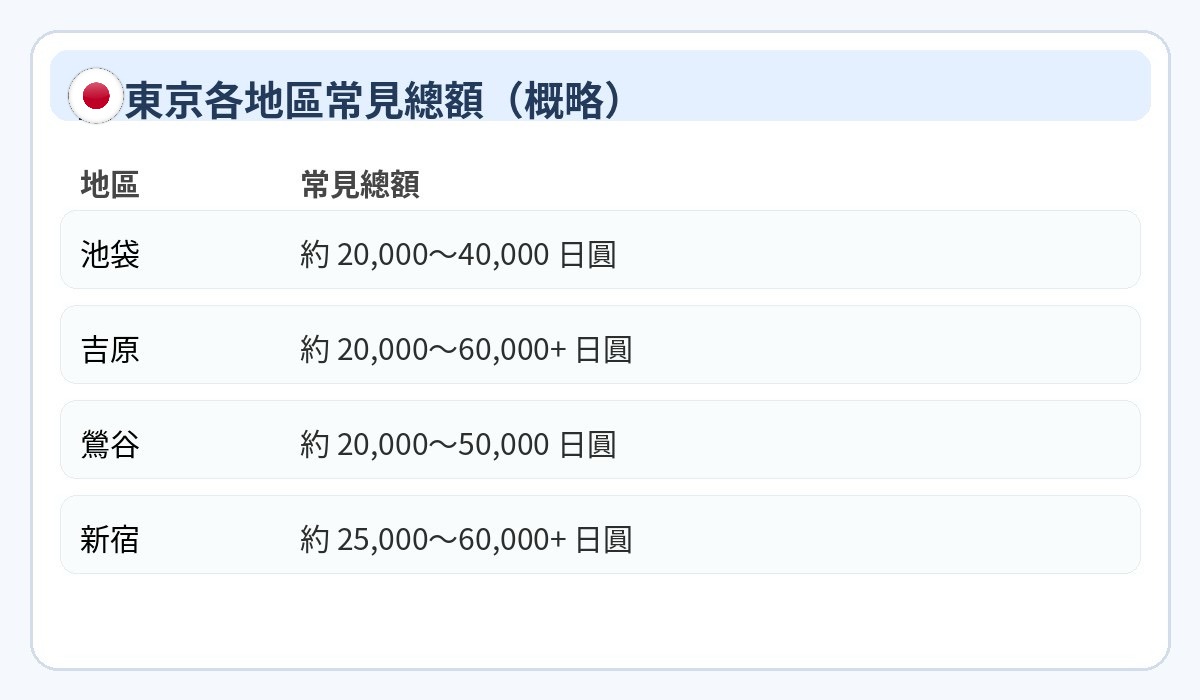
Therefore, the information below should be used only as a rough guide for budgeting purposes, not as fixed pricing:
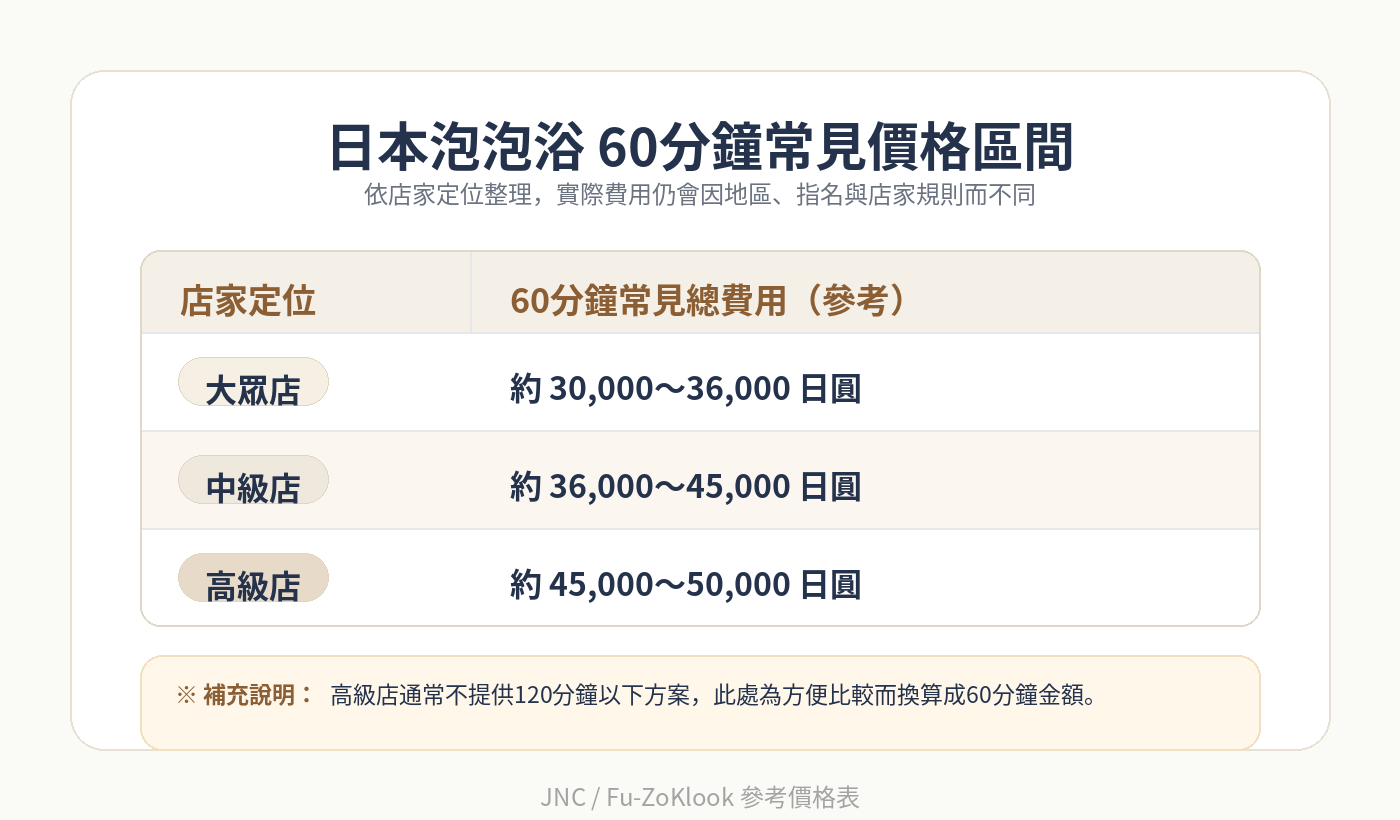
How to Understand Price Differences by District?
 🚕 Transportation Options by Area: Traveling from Major Tokyo Stations and Airports
Travel time varies depending on the departure point, transfers, walking speed, and real-time traffic conditions. Therefore, the information below focuses on general route directions rather than providing overly precise minute-by-minute estimates.
🚙 Getting to Yoshiwara
Common options include:
・Take the Tokyo Metro Hibiya Line to Sannomiya Station, then walk or take a taxi ・Take
the Tokyo Metro Hibiya Line to Iriya Station, then walk or take a taxi ・Take a
taxi from Ueno Station or
Asakusa Station ・Use the pickup or meeting arrangements provided by the establishment
Sannomiya Station is still a bit of a walk from the heart of Yoshiwara; based on some on-site observations, it takes about 10–15 minutes, but the actual time may vary depending on the location of the specific establishment.
If it’s your first visit, you’re arriving at night, or you’re unfamiliar with the area, taking a taxi from Ueno, Asakusa, or Sannomiya is usually the easiest option.
🚙 Getting to Shinjuku Kabukichō
You can use:
・JR Shinjuku Station East
Exit ・Seibu Shinjuku Station ・Toei Oedo Line Shinjuku-Nishiguchi Station ・Tokyo
Metro Shinjuku-Sanchome Station
Kabukichō covers a large area, and venues may be located near Shinjuku East Exit, Seibu Shinjuku, or Higashi-Shinjuku, so don’t just head there based on the name “Shinjuku” alone.
🚙 Getting to Ikebukuro
Accessible via:
・JR Ikebukuro Station ・Tokyo
Metro Marunouchi Line
, Yurakucho Line, Fukutoshin Line ・Tobu Tojo Line ・Seibu Ikebukuro Line
It’s especially important to check the exit before making a reservation. Ikebukuro Station has many exits and a complex network of underground passages; the North, West, and East Exits are in completely different directions.
🚙 Traveling to Uguisudani
You can take:
・JR Yamanote
Line・JR Keihin-Tohoku Line
Uguisudani Station is just one stop from Ueno, making the trip straightforward. However, if your actual destination is Yoshiwara, you’ll still need to continue on foot or take another train.
✈️ From Haneda Airport
If your accommodation or destination is in Shinjuku or Ikebukuro, you can first head into central Tokyo and then transfer to the JR or subway.
If your destination is Kawasaki, traveling from Haneda is usually the most convenient route.
If your destination is Yoshiwara, you can usually head to Ueno, Asakusa, or the eastern part of Tokyo first, then transfer to the Hibiya Line or take a taxi.
✈️ From Narita Airport
If your destination is Yoshiwara or Uguisudani, Ueno is usually a convenient transfer point.
After arriving at Keisei-Ueno via the Keisei Line, you can transfer to the subway, JR, or a taxi to reach your destination.
Which area is recommended for first-time foreign visitors?
Just because an area is the most famous doesn’t necessarily mean it’s the best fit for international visitors.
When choosing a place for the first time, I recommend evaluating options in the following order:
First: Does the establishment explicitly welcome foreign visitors?
This is more important than the neighborhood. This is more important than the neighborhood. This is more important than the neighborhood. Say it with me three times!
Some establishments accept foreigners but require:
・The ability to communicate in basic Japanese ・Presentation of a passport ・Reservations made through
a designated channel ・Prior confirmation of
nationality
・Compliance with specific payment and cancellation policies
If you haven’t confirmed these details in advance, you might not be allowed to enter the establishment even if you’re in a well-known area.
If you’re concerned, feel free to let the JNC team handle your reservation!
Second: Is pricing transparent?
Prioritize establishments that clearly explain the following:
・Session duration ・Base
price ・Booking fee ・Whether
there are additional service charges ・Total amount (cash
or credit card) ・Cancellation
and late arrival policies
Third: Is the Transportation Convenient for Your Accommodation?
If you’re staying in Ueno or Asakusa: Yoshiwara is on the way. If
you’re staying in Shinjuku: Kabukichō and the surrounding Shinjuku area are more convenient. If
you’re staying in Ikebukuro: Prioritize options in Ikebukuro to avoid traveling between cities. If
you’re staying near Shinagawa, Kamata, or Haneda: You might also want to consider Kawasaki.
Fourth: Is there someone to assist with communication?
For travelers who do not speak Japanese, having access to Chinese or English customer service—or a trusted Concierge—is more valuable than simply choosing a well-known area.
Expert Summary:
If you want to see the widest selection of establishments and the most comprehensive pricing options: Choose Yoshiwara.
To have dining, lodging, and nightlife all in one place: Choose Shinjuku.
If you want to combine shopping, anime-related activities, and convenient transportation: Choose Ikebukuro.
If you’re staying near Ueno and your itinerary is already set: Consider Uguisudani or use it as a transportation hub for exploring eastern Tokyo.
However, no matter which area you choose, don’t follow street touts directly into a shop, and don’t make decisions based solely on a single photo or the lowest price.
Summary
It’s true that Tokyo’s most iconic soapland district is Yoshiwara in the Senzoku area of Taito Ward. But other districts also have their own unique charms and establishments worth exploring.
Choose an area first, then select an establishment; confirm the total cost first, then arrange transportation. We recommend using this process as a guide when planning your first Tokyo Soapland trip.
Fu-ZoKlook x JNC Official LINE & Major Social Media Platforms
If you have any questions about Japanese adult entertainment or making
reservations, or if you’d like to consult with us, feel free to click the image below to join our official LINE account. JNC will provide you with free consultation services ♥
We’ll continue to update with more knowledge and content related to Japan’s adult entertainment scene, so please stay tuned and keep supporting us, fellow enthusiasts!
You can also follow our social media accounts to stay up-to-date on the latest news about Japan’s adult entertainment scene 👇
👉Fu-ZoKlook x JNC on Major Social Media Platforms