
When searching for Japanese Soaplands (Soapland), many people have likely heard stories about how “the photos look very different from the actual person.” While it’s impossible to completely avoid photo fraud (パネマジ), understanding how to evaluate photos and knowing what to look for when verifying information about the establishment and staff can significantly reduce your chances of having a bad experience.This article will start with the basics of “photo fraud” (panemaji) and cover techniques for verifying the authenticity of photos, selection methods for beginners, and how to identify trustworthy establishments.
What Is “Photo Fraud” (Panemaji, Photoshopped)?
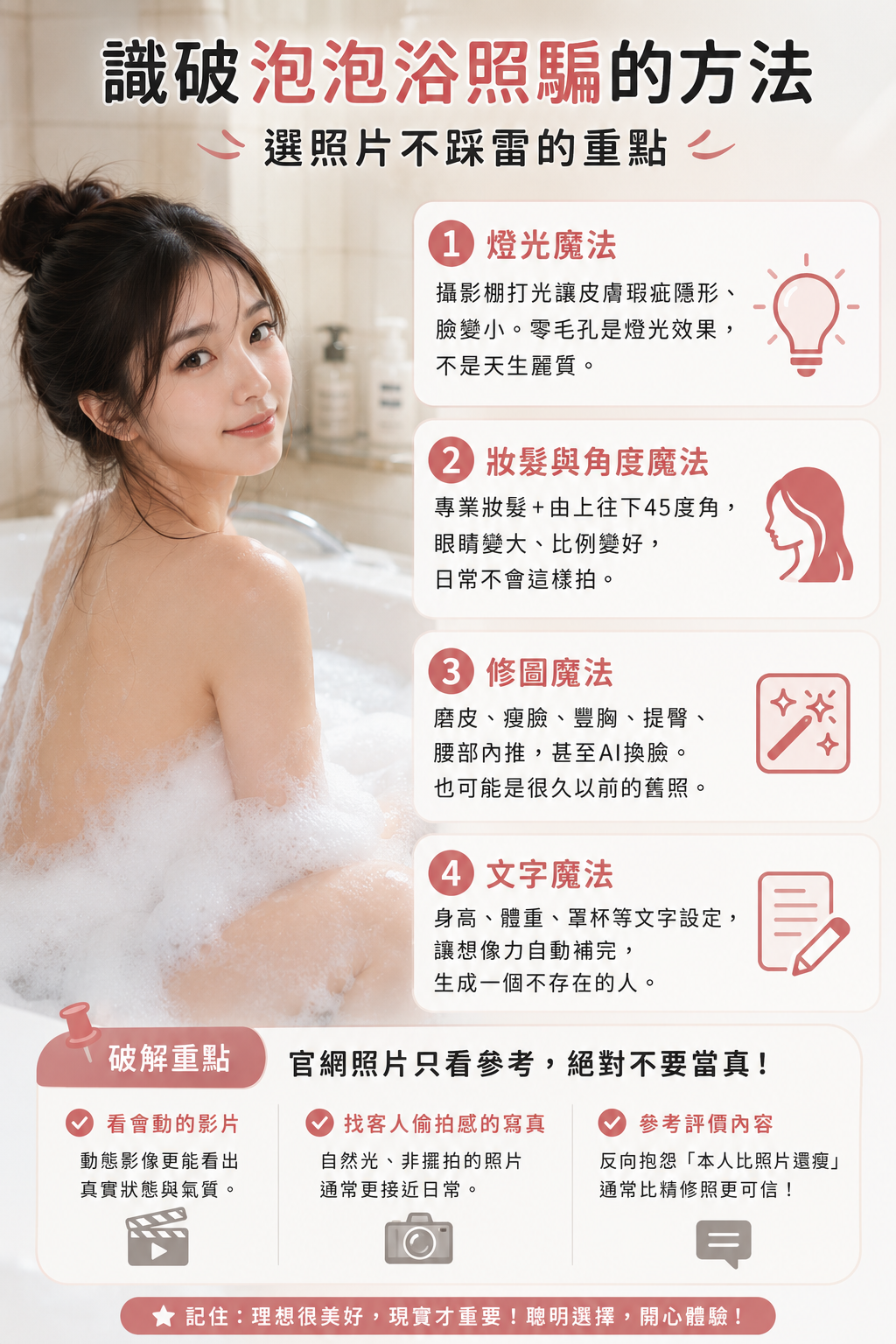
It’s “panel magic.”
In the past, Soapland parlors would display a row of introduction panels featuring girls at their entrances, and customers would choose their companion based on those panels. The result? The girls on the panels looked like angels, but upon entering the room and seeing the real person, customers instantly wondered if they’d walked into the wrong place. This disparity is what’s known as “photo fraud.”
Nowadays, physical display boards are a thing of the past—everything has moved online—but this “magic” hasn’t disappeared; it’s actually evolved into something even more terrifying.
The four layers of “Panemaji” (Photoshopped) magic, stacked one on top of the other:
The first layer: the magic of lighting.
With the right studio lighting, skin imperfections vanish instantly, and the face looks a whole size smaller. The “zero-pore” skin you see is created by lighting—not natural beauty.
Layer Two: Makeup, Hair, and Angle Magic.
With the help of a professional makeup and hair team, eyes appear twice as big, and nose contouring makes you look like a half-model. Combined with a 45-degree downward angle, your leg proportions instantly become those of a model—something you’d never actually do in everyday life.
The third layer: photo editing magic.
This is the most extreme. Skin smoothing, face slimming, Big Breast, butt lift, waist slimming—and now there’s even one-click AI face swapping. Some salons will even dig up photos from ten years ago; what you see is her at 25, but the person who shows up is 35.
The fourth layer: text magic.
Adding a line beneath the photo—say, “Height: 160 cm, Weight: 45 kg, G-cup”—allows your imagination to automatically fill in the blanks, instantly creating a person who doesn’t actually exist in your mind.
So, broadly speaking, “Panemaji” (Photoshopped) is no longer just a term specific to the adult entertainment industry. Dating apps, online shopping models, and live-streaming filters—they’re all “Panemaji” (Photoshopped). The core concept is the massive gap between the idealized presentation in advertisements and the reality of everyday life.
Breaking this spell is simple—just remember one thing: treat official website photos as a reference only, and never take them at face value. Moving videos, candid-style photos taken by customers, and even negative reviews stating that the person is “thinner in person than in the photos” are usually a hundred times more reliable than the heavily retouched, glowing official photos.
Why Do “Photo Scams” Exist?
Many people assume that “photo scams” mean the salon is deliberately trying to deceive you, but it’s not that simple. Rather than malicious fraud, it’s a marketing tactic forced upon them by the industry structure—they simply can’t survive without retouching.
1. Advertising Competition: If You Don’t Stand Out, You’re Doomed
The density of Soapland parlors is extremely high—there might be over a dozen on a single street. When customers browse online, they spend an average of just 3 seconds looking at each girl’s photos. If the photos aren’t bright enough, white enough, or striking enough within those 3 seconds, the customer’s finger will simply swipe past them. In a world where click-through rates are a matter of survival, the authenticity of an unretouched, natural look is the least competitive feature.If you don’t retouch your photos, the shop next door will, and all your customers will flock to them—it’s an arms race.
2. Studio photo shoots are, by their very nature, massive photo fraud scenes
Even if a shop has absolutely no intention of retouching, the conditions of a professional studio shoot automatically create photo deception. The studio’s ultra-powerful softbox lights make pores, acne scars, and dark circles vanish the moment they’re turned on.Wide-angle lenses make faces look smaller and legs look longer. Add to that a professional makeup artist who maximizes facial contours and a hairstylist who makes hair look more than twice as voluminous. The final result looks like a completely different person compared to the same person with no makeup under a fluorescent light in their room—it’s not photo editing; it’s physical magic.
3. Platform Rules Force You to Blur the Image
This is the most frustrating part. Many advertising platforms and lead-generation websites in Japan, in order to comply with regulations, prohibit showing overly realistic details. Tattoos, scars, and even skin texture that’s too clearly visible are all off-limits. To get their ads approved, businesses have no choice but to apply heavy soft-focus, blurring, or mosaic-style filters. What was originally meant to be a subtle cover-up ends up turning the entire face into a doll-like blur, making it look even less realistic.You might think the business is trying to deceive you, but in reality, platform rules force them to do it this way.
4. There’s another unspoken secret: the photos are too old
A girl’s appearance changes over time, but photo shoots are expensive—it’s impossible to take new ones every month. Many shops use old photos from two or three years ago, or even pictures from when she first joined the shop and was at her slimmest and most attractive. This isn’t a technical issue; it’s a cost issue. As they keep reusing old photos while new girls keep joining, the discrepancy becomes increasingly obvious.
So rather than viewing “panemaji” (Photoshopped images) as mere deception, it’s better to see it as the kind of advertising enhancement we encounter every day. Think of bubble tea posters or real estate renderings—aren’t they all retouched to a glowing perfection? Once you understand this dynamic, you’ll stop getting angry over misleading photos and instead calmly ask yourself: “How much has this ad been retouched? What discount should I factor in?”
How much can you really trust those Soapland photos?
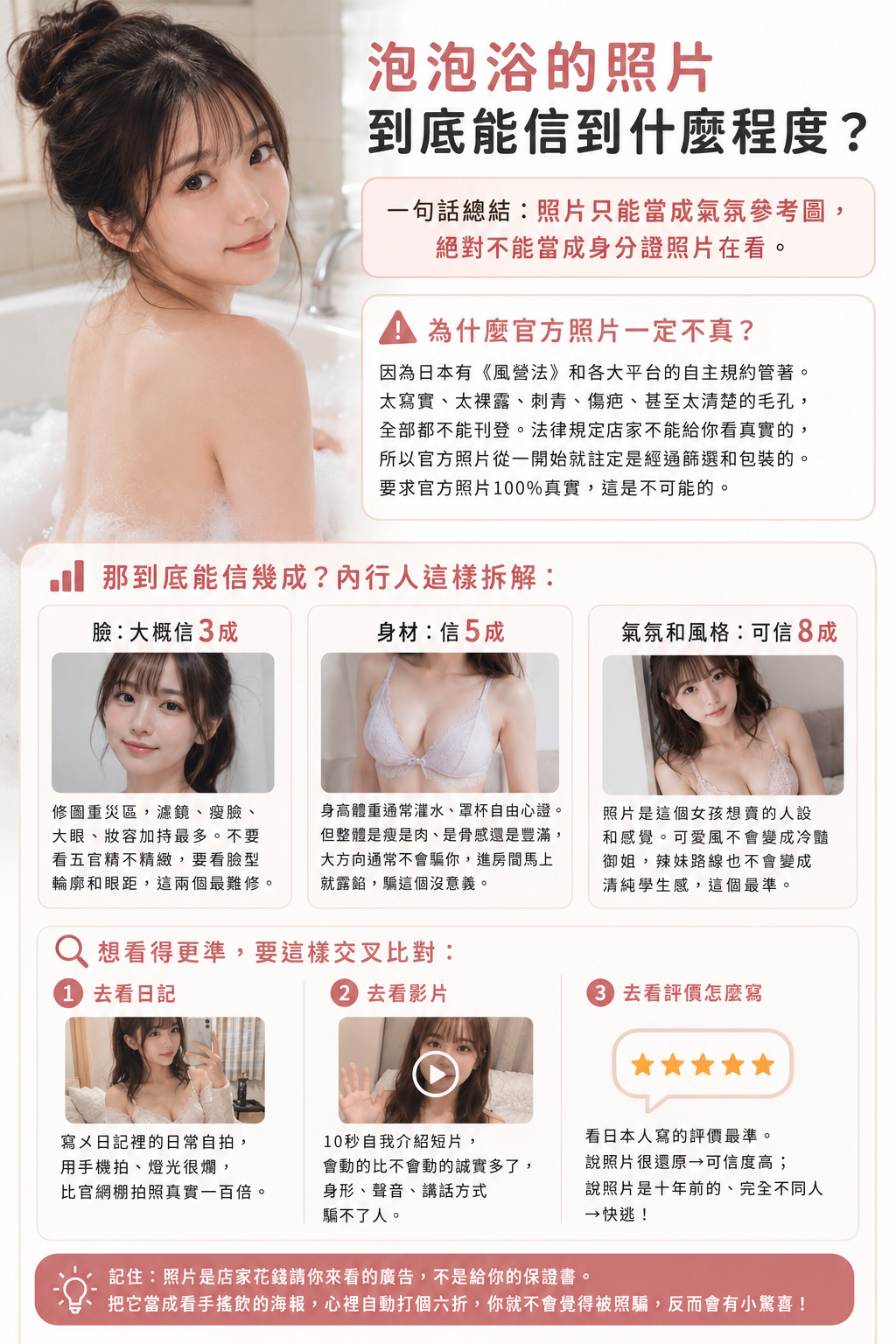
To sum it up in one sentence: photos of Soapland should only be treated as atmospheric references—never as if they were ID photos. If you approach them with the same expectations as you would an ID photo, you’re guaranteed to be disappointed.
Why are official photos never realistic?
Because Japan has the “Adult Entertainment Business Act” and the self-regulatory guidelines of major platforms in place. Anything too realistic, too revealing, tattoos, scars, or even pores that are too visible—none of it can be published.The law prohibits establishments from showing you the real thing, so official photos are bound to be curated and staged from the very beginning. Expecting official photos to be 100% authentic is like demanding that a real estate rendering match the actual finished property—it’s simply impossible.
How reliable are those Soapland photos, really?
Here’s how insiders break it down:
Face: Trust about 30%. This is the most heavily retouched area—filters, face-slimming, eye-enlargement, and makeup all play a major role. On the official website, everyone looks like a half-breed actress, but in reality, they’re more like the girl next door. When looking at photos, don’t focus on whether the features are delicate; instead, look at the facial contours and the distance between the eyes—these two elements are the hardest to retouch.
Body: Trust about 50%. Height and weight are often exaggerated—a listed 160 might actually be only 156, and bra cup sizes are entirely up to personal interpretation. But the overall impression—whether she’s slim or curvy, bony or chubby—usually won’t deceive you, because the truth comes out the moment you enter the room; there’s no point in lying about that.
Atmosphere and style: Trust about 80%. If the photos have a Cute vibe, the girl who shows up usually won’t be a cool, alluring older woman. If the photos go for the “Gal” look, she won’t have a Pure schoolgirl vibe. The photos convey the persona and vibe the girl is trying to sell—and this is actually the most accurate part.
If you want a more accurate assessment, cross-reference the following:
1. Check her diary. Many girls post daily selfies on the club’s blog or their personal pages—what’s known as a “text diary.” Those photos taken with a cell phone, with terrible lighting and a bedroom backdrop, are a hundred times more authentic than the studio shots on the official website.
2. Watch the videos. Many establishments now post 10-second self-introduction clips. Moving images are far more honest than still ones—you can’t fool anyone with her figure, voice, or way of speaking.
3. Check the reviews. Insiders always look at reviews written by Japanese customers. If the reviews say the photos are accurate and she’s even cuter in person, that’s a strong sign of credibility. If the reviews keep saying the photos are from ten years ago or that she looks like a completely different person, run away fast.
Remember, the photos are advertisements the shop pays to show you—they’re not a guarantee. Treat them like a poster for a bubble tea shop: automatically discount them by 40%, and you won’t feel like you’ve been tricked by fake photos—instead, you’ll be pleasantly surprised.
7 Key Points for Spotting “Photo Scams”
If you base your judgment solely on photos, you might feel that “she’s not what I imagined” when you actually meet her. Below are 7 key points to check when identifying “photo fraud” (panemaji), including how to review photo diaries, read reviews, and compare different photos.
1. Check the Photos in Her Diary
Photos in diaries are usually selfies taken with a smartphone. Since the lighting and camera settings are closer to everyday conditions, they reveal the frequency of changes in makeup, hairstyles, and body shape better than the main studio-shot photos. If the diary hasn’t been updated in a long time, or if it only contains landscape photos and text, there’s a lack of material for cross-referencing.
2. Compare Multiple Different Photos
A single angle is most prone to misjudgment. Examine photos from the same period that feature different outfits, backgrounds, and photographers, and observe whether the facial contours, shoulder-to-neck proportions, and jawline remain consistent—this is the most basic method for assessing the extent of photo editing.
3. Check reviews regarding physical appearance
The key to evaluating public comments isn’t whether they’re positive or negative, but whether the descriptions are specific. Abstract terms like “Cute” or “tallest” have little reference value. Comments that mention observable details—such as height, body proportions, voice, or overall vibe—are more useful for cross-referencing with photos.
4. Watch for excessive editing and filters
Common signs of excessive editing include: skin with absolutely no texture; an overly smooth bridge of the nose and jawline; distorted straight lines in the background; unnatural highlights in the eyes; and blurred edges of hair strands. These are common traces left by portrait editing software and apply to portrait advertisements across all industries.
5. Choose Models with High Update Frequency
A high update frequency indicates a consistent supply of new material for comparison. A photo library spanning a longer time period makes it easier to assess consistency than one with only three retouched main images. This is a general principle of content marketing.
6. Verify the “by-name” request rate and repeat customer rate
The “request rate” is a marketing metric commonly used by businesses, representing the proportion of repeat customers. Note that this figure can be defined and calculated by the business itself without third-party verification; a high number does not necessarily mean the model’s appearance meets expectations—it may also reflect service attitude or communication skills. It is more accurate to treat this as one of several reference indicators rather than an absolute standard.
7. Prioritize Photos That Convey Atmosphere
Compared to close-ups of facial features, photos that show full-body proportions, posture, and natural expressions typically leave less room for retouching and better convey the model’s overall aura. Many consumer protection articles recommend that a consistent overall vibe is more important than a single “perfect” photo.
Photo Selection Tips for Beginners
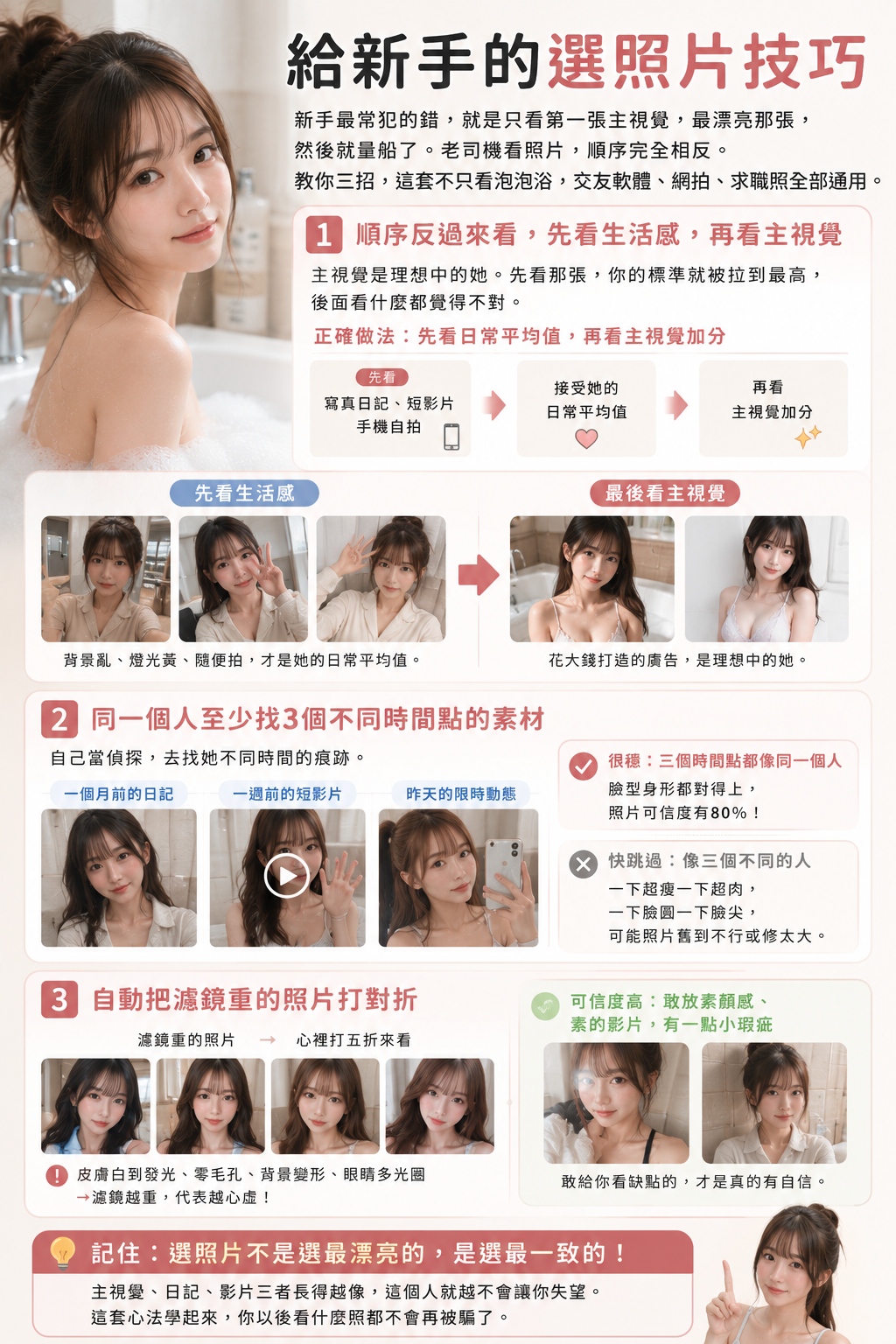
The most common mistake beginners make is focusing solely on the first main photo—the prettiest one—and getting carried away. Experienced users approach photos in the exact opposite order. Here are three tips that apply not only to Soapland photos but also to dating apps, online shopping, and job applications.
Tip #1: Reverse the order—look at the candid shots first, then the main visual
The main visual is an advertisement created by a team of photographers, makeup artists, and photo editors—it’s the idealized version of her. If you look at that one first, your standards will be set too high, and everything else will seem off.
The right approach is to start by checking out her photo diary, short videos, and phone selfies. Those photos with messy backgrounds, yellowish lighting, and casual edits using apps like Meitu Xiu Xiu are what represent her everyday reality. Accept her “average” look first. If you find her average look acceptable, then the bonus points from the main promotional shot are a bonus. If you can’t stand her average look, then no matter how beautiful the main shot is, it’s just a “photo scam.”
Tip #2: Find content from at least three different time periods for the same person
Businesses these days are smart—they post their best photos on their official website and never update them. You have to play detective yourself and look for traces of her from different times. For example, a diary entry from a month ago, a short video from a week ago, or a Story from yesterday.
If the person looks the same across all three time points—with matching facial features and body shape—then this person is a safe bet, and the photos have an 80% credibility rating. If the person looks like three different people across the three time points—sometimes super skinny, sometimes super curvy; sometimes with a round face, sometimes with a sharp one—that means the photos are way too old, or the photo editor changes every month. Skip them immediately.
Tip #3: Automatically Cut the Value of Heavily Filtered Photos in Half
Learning to spot filters is a survival skill for modern people. When you see photos where the skin is so pale it glows, there aren’t a single visible pore, the background is distorted, or there are more than two highlights in the eyes, automatically take the image with a grain of salt—cut the credibility in half.
The heavier the filter, the more insecure the seller is—and the more they’re trying to hide something. On the other hand, photos that dare to show a natural, makeup-free look, post unedited videos, or let you see a few minor imperfections are usually closer to the person’s real appearance. Those who dare to show their flaws are the ones who are truly confident.
Remember, when choosing photos, don’t pick the prettiest ones—pick the most consistent ones. The more similar the main profile photo, daily posts, and videos look, the less likely this person is to disappoint you. Once you master this approach, you’ll never be fooled by any photos again.
To avoid being deceived by photos, is it better to choose walk-ins or request a specific escort?
This is the choice where beginners are most easily brainwashed by sales pitches. Many veterans will tell you that walk-ins are all landmines and that only by requesting a specific escort can you avoid being deceived by photos—or, conversely, that requesting a specific escort always leads to photo fraud, while walk-ins are the real gems. Just take it with a grain of salt; there’s absolutely no causal relationship between these two things.
First, let’s clarify what “walk-ins” and “specifically requesting a girl” mean.
Walk-ins, also known as “Free.” You don’t specify anyone; you give your budget and time to the front desk and ask the establishment to arrange a girl who’s currently available. The upside is that it’s usually the cheapest option; the downside is that you have absolutely no idea who’s coming.
A “booked girl” is exactly what it sounds like. You look at photos online, pick a specific girl, and pay a booking fee to have her serve you. The upside is that you have someone to look forward to; the downside is the extra cost—and the higher your expectations, the bigger the letdown.
See the difference? One is like a blind box, and the other is ordering based on a photo. Neither of these has anything to do with whether the photos are real or not.
Why do some people think walk-in customers are less likely to be deceived by fake photos?
Because walk-in customers have no expectations—and without expectations, there’s no disappointment. You don’t know who’s coming to begin with, so whoever shows up is a surprise, and naturally, the discrepancy feels smaller. But this doesn’t mean the girls who come to walk-in customers are more “real”; it just means your psychological expectations are lower. Plus, walk-in customers usually get girls who are relatively free that day or have less experience, so there’s even less photo information available—you don’t even have a chance to compare.
Why do some people think booking by name is safer?
Because when you request a specific girl, you usually get access to more information—photos, diaries, videos, and reviews—so it feels like you have a more complete picture. In theory, the more information you have, the easier it is to spot a “photo scam.” But the problem is, many people who request a specific girl just go for it based on that one most flattering cover photo, without ever cross-checking it against other images. Of course, they still end up getting scammed.
So, the key to avoiding “photo scams” isn’t really about which system you choose
There’s only one core principle: the less information you have, the higher the risk.
If you want to choose a walk-in, that’s fine, but ask the front desk if the girl has any candid photos or short videos you can check out—don’t just go in completely blind.
If you want to request a specific girl, you need to do your homework even more thoroughly. Go through all four types of content—the main profile photo, diary entries, videos, and reviews—and make sure they all look like the same person before paying the request fee.
Instead of agonizing over whether to choose a walk-in or a specific girl, focus on whether you have enough information. With sufficient information, booking a specific girl is safe. Without enough information, both walk-ins and specific bookings are a gamble.
Key Points for Choosing an Establishment That Won’t Let You Down
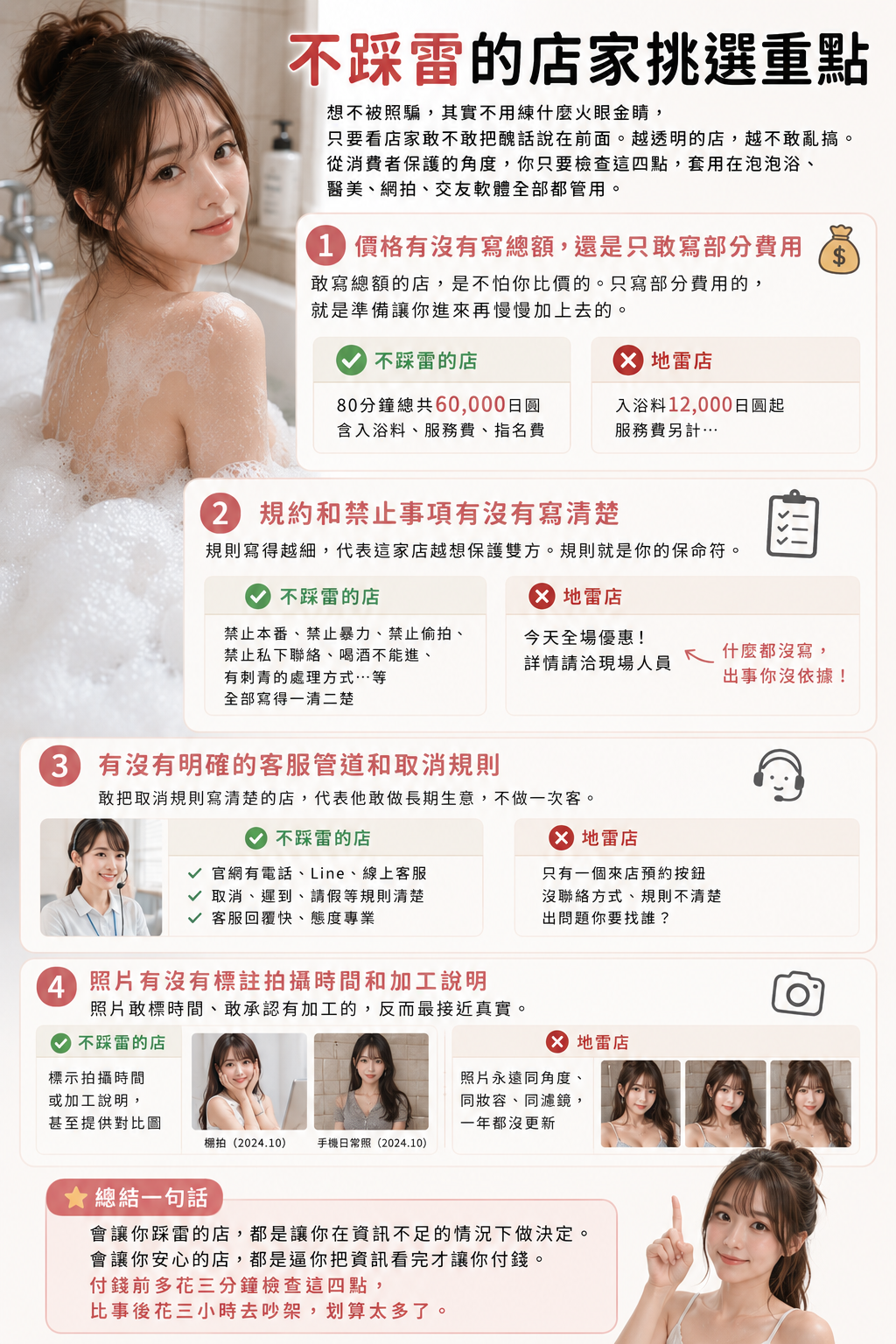
To avoid being scammed by fake photos, you don’t actually need to develop “X-ray vision”—just see if the establishment is willing to be upfront about the downsides. The more transparent an establishment is, the less likely it is to pull a fast one. From a consumer protection standpoint, just check these four points:
1. Is the total price listed, or do they only dare to list partial fees?
This is the most basic indicator of integrity.
A reliable establishment will clearly state the total price—for example, “80 minutes for 60,000 yen total, including bath fee, service charge, and request fee.” A shady establishment will only list the bath fee as “starting at 12,000 yen,” then note in tiny print that the service charge is billed separately. You won’t realize the bill has quintupled until you walk out the door.
Remember: Establishments that list the total price aren’t afraid of you comparing prices. Those that only list partial fees are planning to gradually add more charges once you’re inside.
2. Are the rules and prohibitions clearly stated?
Reputable establishments will lay out their rules in excruciating detail, like a textbook. Prohibitions on sexual intercourse, violence, secret filming, and private contact—as well as policies on alcohol consumption and how tattoos are handled—are all spelled out crystal clear.
You might find all these rules annoying, but the more detailed they are, the more the establishment is committed to protecting both parties. If a place lists nothing but a “Today’s Special” offer on the entire page, you won’t even have grounds to file a complaint if something goes wrong. These rules are your lifeline.
3. Are there clear customer service channels and cancellation policies?
Before placing an order, contact customer service first. Does the official website list a phone number, LINE, or online chat? Are there cancellation fees? What happens if you’re late? What if the girl you requested is on leave?
A trustworthy establishment will list all of this in its FAQs, and their customer service will respond quickly and professionally. If a place is too afraid to provide contact information and only has a “Book Now” button, who will you turn to if something goes wrong? An establishment that clearly outlines its cancellation policy is one that’s committed to long-term business—not just a one-time transaction.
4. Are the photos labeled with the date they were taken and any editing details?
This is the easiest way to gauge a shop’s integrity—and it’s at the heart of the “photo scam” issue.
Reputable shops will proactively label photos with the date they were taken—for example, “Taken in October 2024”—or specify that only brightness adjustments were made. Some even post side-by-side comparisons: a studio shot on the left and a casual smartphone photo on the right—that’s a clear sign of sincerity.
Conversely, if all the photos are taken from the same angle, feature the same makeup, use the same filter, and haven’t been updated in a year, they’re basically treating you like a sucker. The more the photos resemble an advertising catalog, the further they are from reality. Photos that dare to include the date and admit to editing are, in fact, the closest to reality.
To sum it up in one sentence: Shops that will lead you astray are the ones that make you make decisions with insufficient information. Shops that put your mind at ease are the ones that force you to review all the details before letting you pay. Spending three extra minutes checking these four points before paying is far more worthwhile than spending three hours arguing afterward.
Fu-ZoKlook x JNC Official LINE & Major Social Media Platforms
If you have any questions or would like advice
regarding Japanese adult entertainment or making reservations,
feel free to click the image below to join our official LINE account. JNC is here to provide you with free consultation services ♥
We’ll continue to update our content with more information about Japan’s adult entertainment scene, so please stay tuned and show your support!

You can also follow our social media accounts to stay up-to-date on the latest news about Japan’s adult entertainment scene 👇