Is it okay to take photos or videos at Japanese Soapland (Soapland)? This article covers cell phone usage inside the establishment, the privacy of female staff, posting on social media, the risks of covert filming, as well as the photography rules and basic etiquette that foreign visitors must follow when visiting Soapland for the first time.
When visiting a Japanese Soapland (ソープランド) for the first time, many foreign travelers have one question:
“Can I take photos with my phone?”
Some may want to take photos of the interior decor or room amenities, or even wonder:
“It should be okay to just take a picture of myself, right?”
“Can I record video if the woman gives her consent?”
“Is it okay if I don’t post it online and just keep it on my phone?”
“Can I take a souvenir photo at the entrance?”
In regular restaurants or tourist attractions, it’s perfectly natural to take out your phone to take photos.
However, a soapland is not a typical tourist attraction.
The premises may involve female staff members who are nude, the privacy of other guests, and highly private service areas; therefore, the rules regarding photography, video recording, and cell phone use are typically stricter than in ordinary stores.
First, remember this most important rule:
Do not take photos, record videos, or make audio recordings without the establishment’s explicit permission.
There is no single, nationwide rule in Japan that simply states “photography is strictly prohibited in all Soaplands”; establishments can set their own photography policies based on their management discretion, and it is common for commercial facilities to require customers to comply with their photography policies. If an establishment prohibits photography, customers should comply.
Furthermore, in situations involving nudity or sexual acts, secretly filming without the subject’s consent may amount to more than just a “violation of store rules.”
Japan’s “Act on Punishment for Photography of Sexual Poses, etc.” has been in effect since 2023; under certain conditions, secretly photographing another person’s genitals, underwear, or sexual acts—that is, “sexual poses”—may constitute a criminal offense.
Therefore, for foreign travelers, the safest and simplest approach is:
Once you enter Soapland or any adult entertainment establishment, treat your cell phone as an item that “should not be used for photography in principle.”
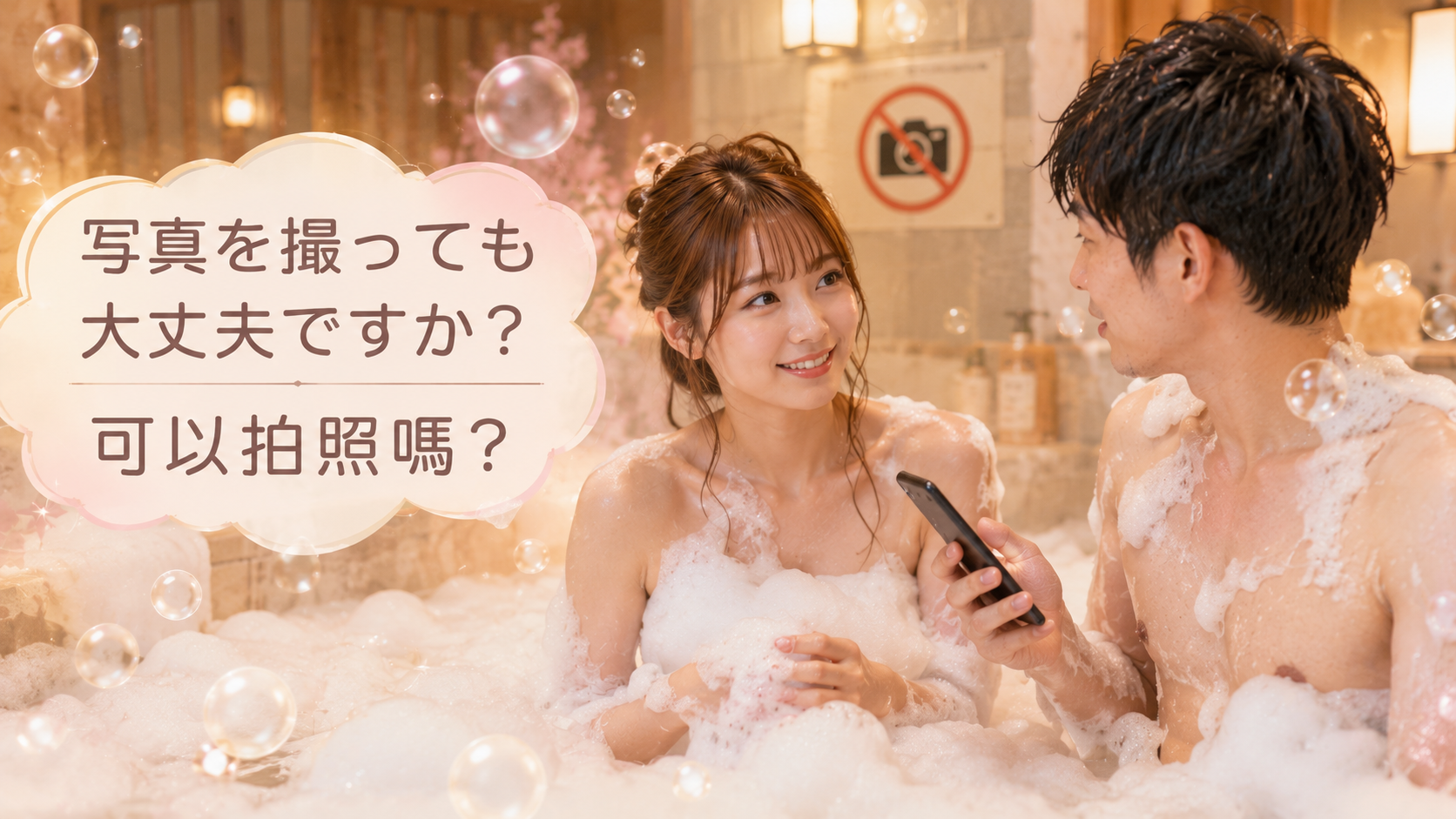
Is photography and video recording completely prohibited in Soapland?
The most accurate answer is:
Please refer to each establishment’s specific rules, but unauthorized photography or video recording should not be done.
Management practices may vary from one soapland to another.
For example, some establishments may require that:
-
Put your phone in your bag before entering the room
-
No use of the camera function in the service area
-
No photography of female staff
-
No audio or video recording
-
No photography of other guests
-
The use of cell phones is strictly prohibited in certain areas
There may be a few exceptions, such as official photo shoots or promotional events organized by the establishment, or photography of specific content conducted with the explicit consent of both the establishment and the subject.
However, these should all be considered:
“exceptions granted with explicit permission”
rather than:
“Since it’s not explicitly prohibited, filming is allowed.”
In Japan, photography rules for general commercial facilities are typically set by the facility managers themselves; some venues allow limited personal photography, while others restrict video recording, live streaming, capturing other guests in the frame, or posting on social media.
Since soaplands involve an even higher degree of privacy than typical commercial facilities, it’s best to err on the side of caution when visiting for the first time:
When you see signs that say “No Photography,” “No Video Recording,” or “No Audio Recording”:
-
No Photography = Photography Prohibited
-
No Video Recording = No video recording allowed
-
No Audio Recording = No audio recording allowed
If you don’t understand the rules at all, you can ask a staff member first:
“Is it okay to take photos?
”
If you don’t receive a very clear “yes,” don’t take any photos.
Why is photography prohibited?
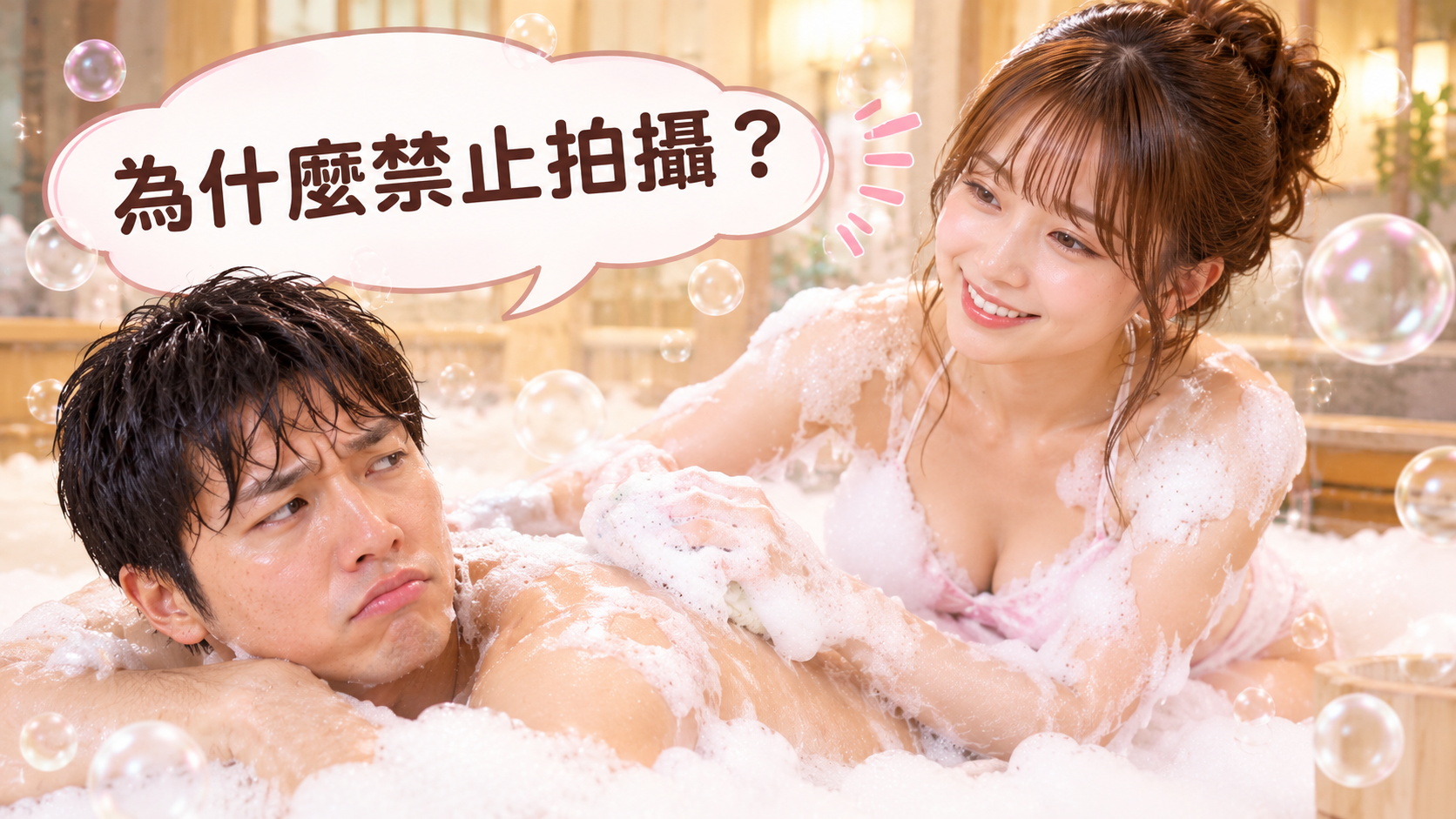
1. To protect the privacy of female staff members
Female staff members may place a high value on their personal identity and workplace privacy for various reasons.
For example:
-
They do not want their family or friends to know the nature of their work
-
They do not want their real appearance to be circulated online
-
They do not want private images to be saved
-
They do not want their images uploaded to adult websites
-
You do not want your photos to be maliciously altered or reposted
Even if there are photos of female staff members on the business’s official website, this should not be interpreted to mean:
“Therefore, I can allow customers to take photos of me freely.”
Photos on the official website are typically published for specific purposes and under specific authorization.
Photos or videos taken by customers in private spaces are an entirely different matter.
This is especially true if the content involves nudity or sexual acts, as Japanese law provides even stronger protection against unauthorized filming in such cases. A relevant law enacted in Japan in 2023 makes the secret filming of “sexual poses” under specific conditions a punishable offense.
Therefore:
“She didn’t stop me” does not mean “she consented to being filmed.”
“Her willingness to provide services” does not equate to “her consent to be recorded.”
Consent to provide services and consent to be filmed are two distinct matters.
2. Business Operations and Safety Management
The
prohibition on photography is also related to the establishment’s operational management.
A Soapland parlor may include:
-
Reception area
-
Waiting area
-
Areas where female staff rest or move about
-
Service rooms
-
Bathroom facilities
-
Other Non-Public Areas
If a guest freely takes out their phone and starts taking photos anywhere in the store, it is difficult for the business to determine:
“Is this a selfie?”
“Or are they taking a picture of a staff member?”
“Did they capture other guests in the shot?”
“Are they recording a video?”
“Are they livestreaming?”
Therefore, directly restricting photography is often the easiest management approach to implement.
Generally, when Japanese commercial facilities establish photography rules, they often prioritize the privacy of other customers, operational order, and safety management.
So even if you’re just thinking:
“The room’s decor is so beautiful—I’ll just take a quick photo,”
the establishment may still ask you to stop taking photos.
In such situations, the most important thing is not to argue with staff by saying, “I didn’t even take a picture of anyone,” but to comply with the establishment’s current rules.
3. Respect the privacy and feelings of other guests
Soapland is a place that places a high priority on guest privacy.
Many people do not want to be:
-
be photographed entering the establishment
-
appear in photos taken in the waiting area
-
be photographed head-on
-
be posted on Instagram, Threads, X, or TikTok
-
have acquaintances figure out their whereabouts through photos
Therefore, even if you aren’t intentionally photographing other customers, simply having people in the background can cause serious discomfort and misunderstandings.
Many commercial facilities in Japan have specific photography guidelines that explicitly require avoiding capturing other guests or staff in the frame; in particular, publishing images of identifiable individuals on social media without consent is more likely to lead to disputes regarding right of publicity and privacy.
Furthermore, soaplands are adult establishments characterized by a high degree of privacy.
Therefore:
Do not point your phone camera at the entrance, reception desk, hallways, or other guests.
Even if you do not press the shutter button, people around you may think they are being secretly photographed.
Precautions When Using Smartphones
⚠️ Rules for Using Cell Phones Inside the Establishment
Since almost everyone carries a smartphone these days, a “No Photography” sign does not necessarily mean you “cannot touch your phone at all.”
However, you should exercise extra caution when using them.
The safest approach is:
Once you enter the store, check the store’s rules first, then decide when it’s appropriate to use your phone.
For example:
✅ Check reservation details
✅ Use a translation app
✅ Check messages
from the store ✅ Pay or confirm contact information
Generally, avoid:
❌ Turning on the camera
❌ Recording
video ❌ Recording audio
❌ Going live
❌ Taking
covert photos ❌ Pointing the camera at other people
are completely different matters.
If you need to use Google Translate, LINE, or other translation tools, please let the staff know first:
“Is it okay to use my phone for translation?
”
This will help prevent them from mistakenly thinking you’re recording.
⚠️ Pay special attention to your camera view
On some phones, the camera can be launched directly from the lock screen.
In places where privacy is highly valued, even if you accidentally tap the camera, it could lead to unnecessary misunderstandings if the lens happens to be pointed at the staff.
Therefore, once you enter the store:
Put your phone away whenever you don’t need to use it.
This is actually the simplest method and the one least likely to cause problems.
⚠️ Can I upload photos to social media?
This needs to be considered in two separate ways:
“Whether you can take a photo” and “whether you can post it publicly” are not the same thing.
Even if a photo was taken with permission, that doesn’t mean it can necessarily be freely shared on:
-
Instagram
-
Threads
-
X
-
Facebook
-
TikTok
-
YouTube
-
Xiaohongshu
-
Blog
Many commercial facilities in Japan have separate rules for “photography” and “posting on social media.” For example, some facilities allow private photography but prohibit uploading photos to social media; others require that photos not include other guests or staff members.
When it comes to soaplands, it’s best to err on the side of caution.
In particular, do not publish the following without permission:
-
Private photos of female staff members
-
Nude content
-
Footage of sexual acts
-
Other customers’ faces
-
Information that could reveal a woman’s true identity
-
Unauthorized access to private areas within the establishment
Japanese police also caution that if images of a private nature are provided to an unspecified or large number of people without the subject’s consent, legal liability under laws regarding “private image recordings” may apply, depending on the actual content and circumstances.
So don’t assume:
“She agreed to let me take the photo, so I can upload it.”
Consent to filming and consent to publication must be considered separately.
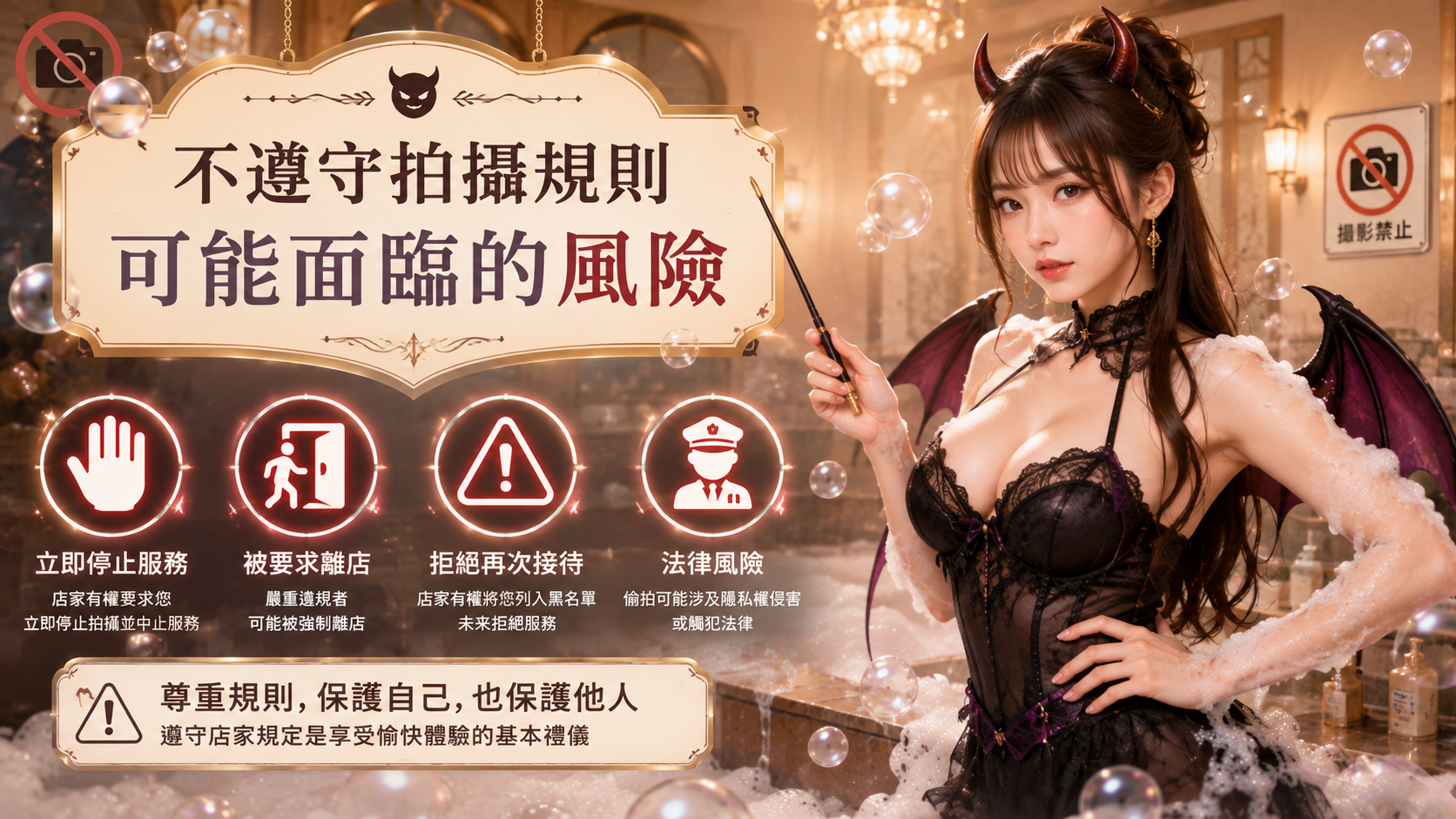
Risks of Not Following Filming Rules
Some people might think:
“At worst, a store clerk will just tell me not to take pictures, right?”
In reality, the consequences could be more serious than you imagine.
1. Being asked to stop filming immediately
In the most basic scenario, a store employee will ask you to put your phone away.
You should comply immediately.
2. Service may be suspended, or you may be asked to leave
Businesses have the right to establish their own rules.
In most Japanese businesses, if a customer ignores the store’s no-photography policy and continues taking photos even after being warned, the store may go so far as to ask the customer to leave or ban them from re-entering.
Similarly, at soaplands, you should not treat the “no photography” rule as something open to negotiation.
3. The establishment refuses to serve you in the future
Adult entertainment establishments may keep records of customer reservations.
If there has been a history of surreptitious photography, serious harassment, or other rule violations, the establishment may refuse future service in accordance with its own policies.
4. Serious Disputes with Female Staff
For staff members, covert filming may mean:
their nudity, work activities, or true identity may be permanently stored on a stranger’s phone.
Therefore, even if a customer claims:
“I’m really just looking at it myself,”
the staff member has every reason to feel uneasy.
5. Serious cases may involve legal liability
This point is very important.
Not all violations of a “no photography” policy automatically constitute a criminal offense.
A simple violation of a store’s photography policy may, first and foremost, fall within the scope of the store’s management and civil disputes.
However, if the content or method of filming involves:
-
secretly photographing nudity
-
secretly photographing genitalia
-
covert filming of sexual acts
-
Obtaining images in a manner that prevents the subject from freely expressing their consent
-
the distribution of specific private sexual images without consent
may further constitute a violation of Japan’s “Act on Punishment for Photography of Sexual Poses, etc.” or other laws related to private sexual images.
Therefore, do not equate:
“Covert filming is merely a violation of store policy.”
as a given.
Depending on the actual behavior, the consequences could be much more serious. Rules and Etiquette for
Foreign Visitors
If this is your first time visiting a Japanese soapland, simply keep the following principles in mind:
① Do not take photos without explicit permission
This is the most important rule.
Don’t make assumptions like:
“It should be okay.”
Instead, stick to:
No permission = No photo
.
② Do not secretly record video or audio
Some passengers, knowing they’ll be caught taking photos, switch to placing their phones on the table to record video or audio.
This does not make it any less problematic.
Especially in private service areas, secret video or audio recording can lead to very serious legal and privacy issues. Since 2023, Japan has had a nationwide penalty system in place for “photographing sexual poses, etc.”
③ Do not take photos just because “the woman agreed”
Even if a female staff member says it’s okay, it’s best to double-check:
whether the establishment permits it as well.
This is because the establishment itself may have its own separate rules prohibiting photography.
Conversely, the same applies:
Just because the venue permits a certain type of photography doesn’t mean you can ignore the subject’s own wishes.
The safest scenario is:
The establishment permits it + the subject gives explicit consent.
④ Do not photograph other customers
Especially:
-
The entrance
-
Reception desk
-
Waiting areas
-
Elevators
-
Hallways
These are all spots where other guests are likely to end up in your photos.
If you’d like to take a photo of the store’s exterior as part of your travel log, you can ask a staff member first.
⑤ Do not post photos on social media without permission
Even if you’ve only taken photos inside the store:
you should still confirm whether posting is permitted before making it public.
If the photo includes female staff members or other customers, you should definitely not post it on your own.
⑥ If you need to use your phone for translation, please let them know first
For international travelers, mobile translation apps are very useful.
If you need to use one, you can simply ask:
“Can
I use a translation app?”
This way, the staff will know why you’re using your phone.
⑦ If a staff member asks you to stop, comply immediately
Even if you don’t understand the reason, don’t argue on the spot or keep taking photos.
You can ask afterward:
“どこまでなら大丈夫ですか?
” “What is allowed?”
Following the establishment’s instructions is the most basic etiquette for avoiding problems at adult entertainment venues in Japan.
Summary
Is it okay to take photos or videos at Japanese Soaplands?
The safest and most accurate way to understand this is:
Rules may vary by establishment, but do not take any photos, videos, or audio recordings without explicit permission.
It’s especially important to remember:
-
Soaplands are not ordinary tourist attractions
-
Establishments can set their own rules regarding photography on the premises
-
The fact that a woman is providing a service does not imply consent to be photographed
-
The presence of photos on the official website does not imply that guests are permitted to take their own photos
-
Do not photograph other guests
-
If you’re using a translation app on your phone, please inform the staff first
-
“Permission to take photos” and “permission to post on social media” are two different things
-
Secretly photographing nudity or sexual acts may constitute a violation of Japanese law
-
If a staff member asks you to stop taking photos, you must comply immediately
For international visitors, the best way to make this judgment is actually very simple:
If you’re unsure whether you can take a photo, don’t take it.
If you really want to capture a memory, ask first:
“Can I take a photo?
”
After receiving explicit permission, follow up with:
“Is it okay to post this on social media?
”
Rather than taking photos without permission and explaining afterward, confirming in advance takes only ten seconds but can prevent major misunderstandings.
At Japanese soaplands, following the photography rules isn’t just a “store policy”—it’s also a basic sign of respect for the female staff, other customers, and everyone’s privacy.
If your Japanese is limited and you can’t understand the establishment’s prohibited activities, cell phone usage rules, or reservation policies, JNC can help you verify the establishment’s information and guidelines in advance.
Understanding the rules before entering the establishment is often much more reassuring than discovering what you can’t do once you’re already there.
Fu-ZoKlook x JNC Official LINE & Major Social Media Platforms
If you have any questions or would like to consult about Japanese adult entertainment or reservations,
feel free to click the image below to join our official LINE account. JNC will provide you with free consultation services ♥
We’ll continue to update with more information and content related to Japan’s adult entertainment scene, so please stay tuned and keep supporting us, fellow enthusiasts!
You can also follow our social media accounts to stay updated on the latest news about Japan’s adult entertainment scene 👇
👉Fu-ZoKlook x JNC on Major Social Media Platforms