Are Japanese Soapland Ranking Sites Really Reliable? Being Number One Doesn’t Necessarily Mean It’s the Best?!
In this post, we’ll walk foreign travelers through how to distinguish between popularity rankings, advertisements, and genuine reviews. We’ll also help you find the establishment that’s best for you by examining factors such as official websites, total price, customer reviews (kuchikomi), support for foreigners, and language support!
When searching for Japanese Soapland (Soapland/ソープランド), have you come across headlines like these?
“Top 10 Popular Yoshiwara Soaplands,
” “Recommended Tokyo Soapland Rankings,
” “2026 Latest High-End Soapland Rankings”
First-timers often think:
“Since they’ve already ranked them for me, wouldn’t it be quickest to just pick the number one spot?”
⚠️But this is exactly where you’re most likely to run into trouble!!
That’s because there’s no single, nationwide “official ranking” for Japanese Soaplands.
The so-called “rankings” on different websites may represent:
-
website traffic
-
Number of user bookmarks
-
Number of reviews
-
Reservation popularity
-
Internal website recommendations
-
PR/Advertising Exposure
-
Metrics set by other websites
Even a major Japanese adult entertainment information website—which is still being updated—clearly states that some establishment rankings are calculated based on **website traffic (アクセス数) over the past 24 hours**, and users can also view rankings for the past month or save their favorites.
In other words:
“Ranked No. 1” sometimes simply means it has received the most clicks recently, rather than being objectively evaluated and deemed the top establishment for service quality.
For foreign travelers, it’s especially important to look a little deeper.
This is because even if an establishment is very popular among Japanese people, it may:
-
not accept foreign tourists
-
Require a certain level of Japanese proficiency
-
only accept reservations made through specific methods
-
Charge different rates for foreign visitors
-
not allow the booking process to be completed using an international phone number
-
Prices may differ from those listed on ranking websites
-
Store policies are not available in foreign languages
So what this article aims to tell you isn’t which ranking site is “the most accurate.”
Rather, it’s about how to use these rankings effectively.
Are Soapland ranking sites worth referring to?
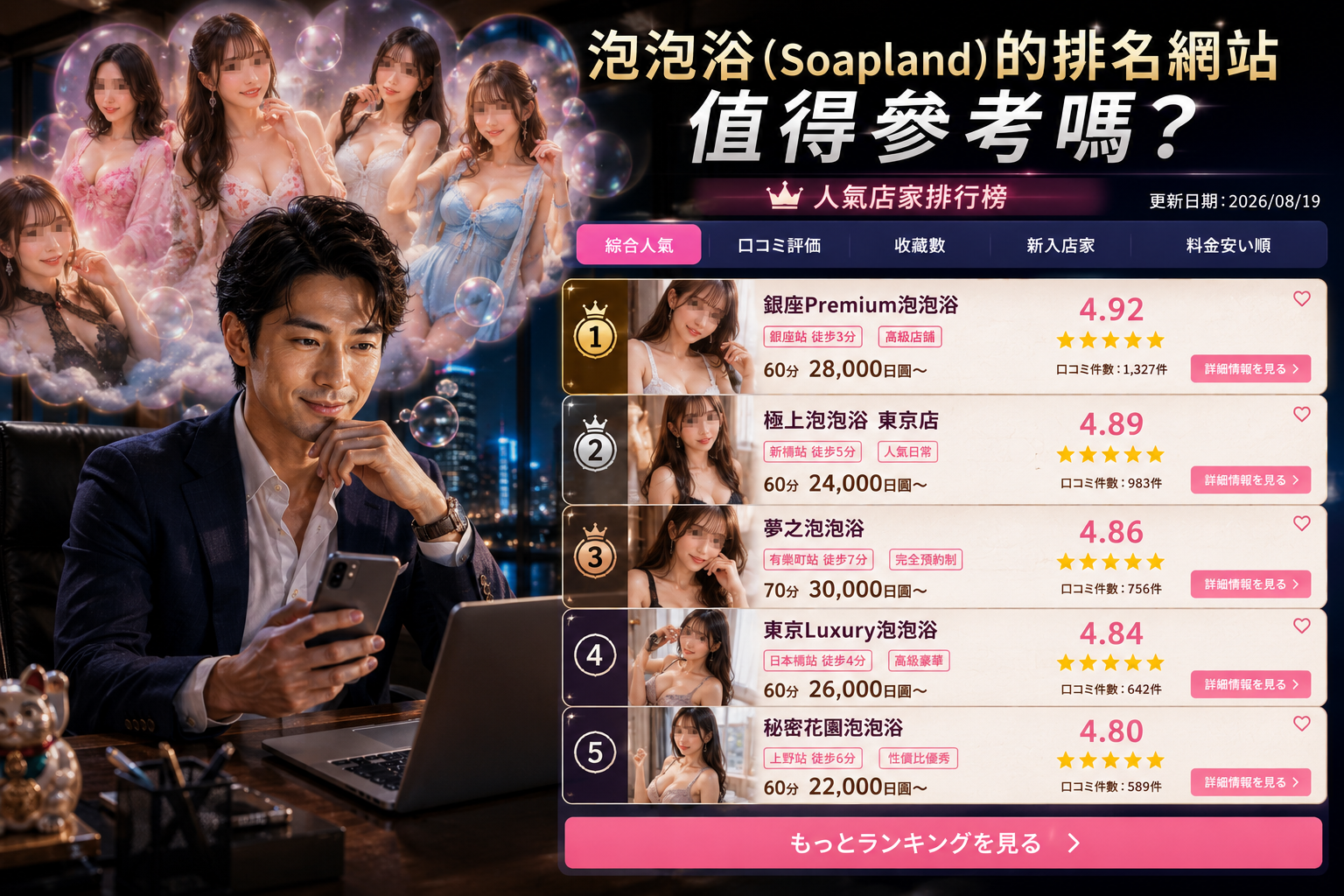
They’re worth checking out, but it’s best to treat them as “search tools” rather than “guarantees of quality.”
If you’re searching for Japanese Soaplands for the first time, ranking sites are actually very convenient.
They let you quickly find out:
-
which areas have a higher concentration of establishments
-
What the approximate price ranges are
-
the main styles of the establishments
-
Business hours
-
Information on female staff
-
Recent availability
-
Authentic User Reviews
-
Store Promotions
Therefore, the greatest value of the rankings is:
helping you quickly narrow down your choices
For example, suppose your search results originally included 30 restaurants.
By using rankings, price, location, and reviews, you can likely narrow it down to 3–5 potential stores in no time.
This is a great way to use the feature.
❌ But don’t jump to the conclusion that:
#1 on the list ⭢ must be the best ⭢ book immediately
⭕ The process I truly recommend is:
Find a few candidates from the rankings → Double-check official information → See if there are recent reviews → Confirm whether they serve Foreigners → Confirm the total price and policies → Then decide.
Quick tip: Consider what “No. 1 in popularity” actually means. When
looking at a ranking, first check one thing: the ranking criteria. These
could include website traffic, number of reviews, number of favorites, editor’s picks, promotional/advertising content, and so on.
For example, “No. 1 in Access Rankings” is closer in meaning to “A lot of people have been searching for this shop recently.”
It cannot be directly translated as: “This shop has the best service quality in all of Japan.”
Once you understand this concept, you’ll be able to interpret Japanese Soapland rankings much more accurately!
What are the characteristics of trustworthy ranking sites?
1. Frequent updates
The first thing to look at isn’t who’s in first place.
Rather: When was this information last updated?
Changes to information on Soapland websites may include:
-
Staff availability
-
Prices
-
Promotions
-
Business hours
-
Reservation policies
-
Booking Fee
-
Can Foreigners Make Reservations?
Some Japanese information websites directly display “Year ____ / Month / Date – Latest” along with the real-time period on which the rankings are based. This design, which “lets readers know when the data was collected,” makes it easier to assess the rankings than those that lack any date information at all.
TIPS | Just seeing the word “Latest” isn’t enough
What you really need to check is:
the update date and whether the business information on the page is regularly updated.
Some articles may change their titles every year to “20XX Latest Edition,” but a closer look at the content reveals that they’re actually reusing old photos and outdated information.
2. Detailed Business Information and Pricing
A truly useful ranking website shouldn’t just feature:
“Super Popular!
” “Highly Recommended!” “No. 1 in Customer
Satisfaction!”
without providing data that actually influences purchasing decisions.
A more practical website should at least allow users to verify:
-
Location
-
Business hours
-
Operating Hours
-
Base rate
-
Booking fee
-
Other Additional Fees
-
Payment Methods
-
How to Make a Reservation
-
Support for Foreigners
-
Official Website Available
Especially regarding prices.
⚠️ “Starting at 20,000 yen” does not necessarily mean the final price will be 20,000 yen
Currently, the publicly available soapland pricing pages still show a wide variety of pricing structures.
For example: Bathing fee + service charge, or: Bathing fee + designated partner fee. Some also list the total amount directly.
Some establishments even explicitly state: “A separate service charge applies,” meaning there is an additional service fee.
Therefore, what’s more important than the lowest price on the rankings is:
What is the actual total amount you’ll end up paying?
When looking at low-price rankings, it’s best to specifically look for the term “Total Amount.”
3. Abundant word-of-mouth reviews and ratings
If someone writes: 💫 “The best experience of my life!”
it doesn’t mean everyone will feel the same way.
Conversely, a single one-star review doesn’t necessarily reflect the business’s overall reputation.
What’s worth paying attention to is: Do the same points keep coming up in the most recent 5–10 reviews?
For example, if multiple people mention, “The pricing was clearly explained,” that’s a more reliable indicator.
If multiple people repeatedly say, “The fees on-site were different from what was listed,” that’s a red flag.
What are the characteristics of ranking sites that require special attention?
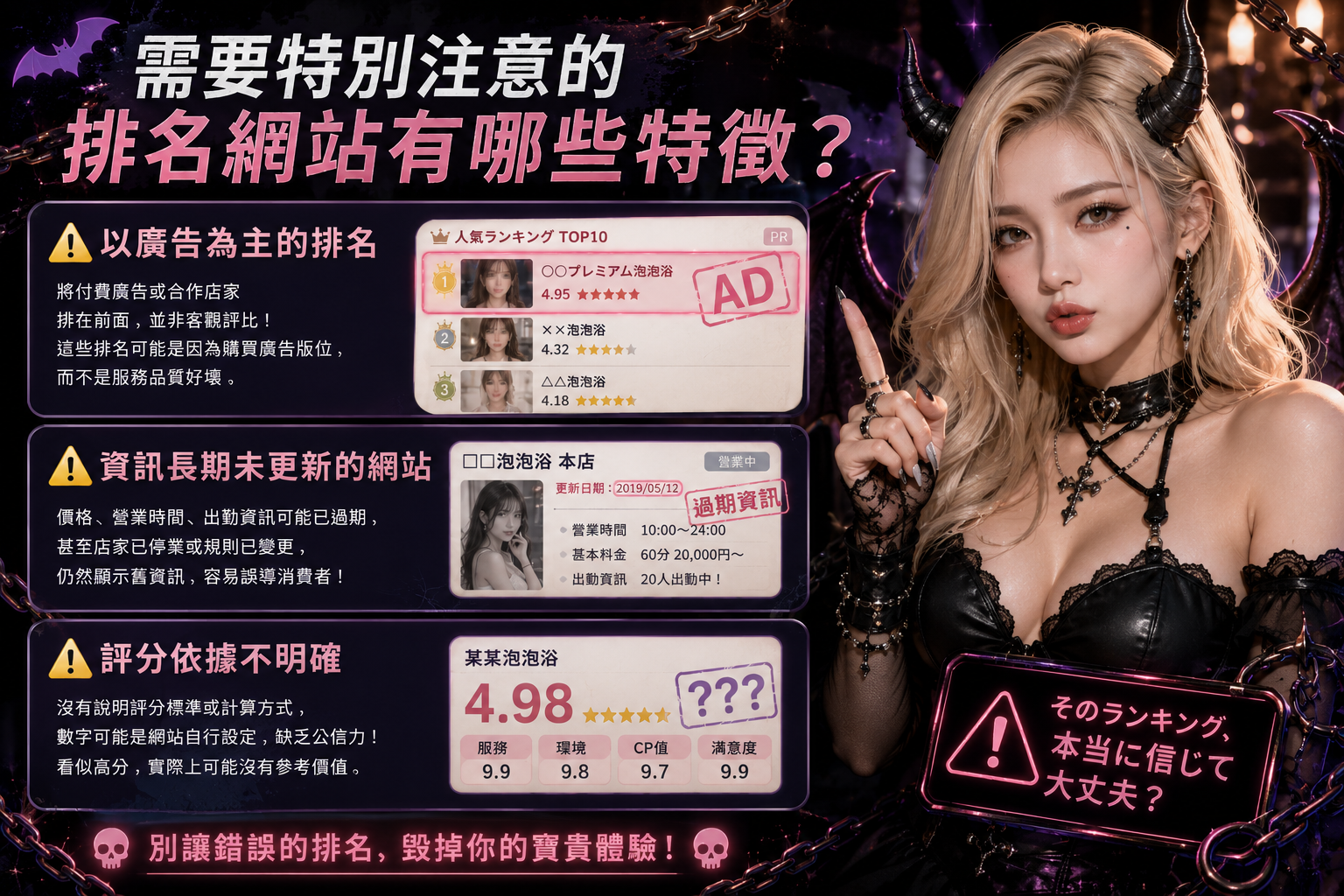
⚠️ Ranking sites dominated by ads
First, let’s clarify:
Just because a website has ads doesn’t mean it’s untrustworthy.
Adult industry information websites may naturally operate through business advertisements, listing fees, or sponsored placements.
What you really need to watch out for is:
whether “ads” are being passed off as “objective rankings.”
If the website clearly states:
-
PR
-
Advertisement
-
Sponsored
-
PICK UP
then readers will at least know: this is promotional content.
The real problem is that it looks like a “ranking list,” but there are no ranking criteria to be found, and it’s unclear whether there’s a commercial relationship between the business and the website.
The safest way to interpret this—when you see an advertised recommendation—is to use it to discover new businesses.
But don’t automatically assume that just because a business is listed at the top, its quality is necessarily the best.
⚠️ Websites with long-unupdated information
This is especially dangerous for foreign travelers.
This is because outdated information may include:
-
outdated prices
-
Outdated business hours
-
Women who have left the establishment
-
Expired events
-
Expired offers
-
Old booking methods
-
Changes to the policy regarding foreigners
In particular, regarding whether foreigners are permitted, you cannot rely solely on old articles.
As of August 2026, currently published business information may still display both “Foreigners Welcome” and “Foreign Customers Not Accepted” (information welcoming and rejecting foreign customers simultaneously)
🩷 If you’re unsure whether a business accepts reservations from foreign customers, feel free to send the details to JNC—we’ll verify it for you!
There are even cases where:
pricing structures that list “foreigners” as a separate category with additional fees.
This means:
You really can’t just guess on your own when it comes to whether a business accommodates foreigners.
You shouldn’t assume: “There are a lot of foreigners in this area, so it should be fine.”
Nor should you assume: “Since the rankings are listed in Chinese, foreigners must be able to go there.”
You must double-check with each establishment when making a reservation!
⚠️ The rating criteria are unclear
If you see:
Beauty: 98 Service: 99
Value for Money: 97
Overall: 9.9
Don’t be too quick to believe it.
First, ask: How were these scores calculated?
Is it:
-
User averages?
-
Editorial ratings?
-
Votes?
-
Page views?
-
Number of reservations?
-
Provided by the business itself?
-
Not listed at all?
If there’s no explanation, you can only treat the numbers as a rough guide.
Especially when it comes to: how attractive the place is, how good the service is, and whether it’s worth it—
—these are highly subjective. I recommend focusing on reviews from actual customers!
Besides the rankings, what other information should you check?
The business’s official website
After finding a few candidate businesses on ranking sites, the next best step is to check each one’s official website for firsthand information based on your preferences.
Prioritize checking:
-
Latest prices
-
Business hours
-
Latest availability
-
Booking Methods
-
Prohibited Activities
-
Payment Methods
-
Event Details
-
Terms of Use for Foreigners
If the information on third-party websites or the official website differs from what you received at the time of booking:
The contact confirmation from the merchant at the time of booking shall prevail!
Reputation and User Reviews
It’s best not to rely on just one website.
You can cross-reference:
Ranking sites + other reviews (kuchikomi) + official information
When reading reviews (kouki), we recommend paying special attention to three types of information:
① Recent reviews
Recent experiences are usually a better indicator of current conditions than five-star reviews from several years ago.
② Verifiable information
For example:
“What was the total bill?
” “How did the reservation work?”
“How long was the wait?”
are usually more helpful than simply saying “It was awesome” or “This place is amazing.”
③ Recurring Reviews
It’s only worth considering when different users repeatedly mention the same strengths or weaknesses.
Whether the establishment welcomes international travelers and provides language support
If you’re a foreign traveler, the importance of this factor should even be ranked:
the rankings.
Currently, policies regarding foreign visitors vary significantly from one Japanese soapland to another.
At a minimum, you should confirm:
① Are foreigners allowed?
Look for:
“外国人歓迎
,” “外国人OK
,” or “Foreigners Welcome”
and similar phrases.
However, even if you see such information, it’s recommended to double-check when making a formal reservation.
② Are there any language requirements?
"Open to foreigners" does not necessarily mean:
Chinese-language service is available.
Some restaurants may only:
-
offer basic English
-
Require basic Japanese
-
use a translation app
-
Require reservations through a specific channel
Therefore:
"Foreigners Welcome" ≠ "Chinese OK"
These two things must be considered separately.
③ Are the prices the same for foreign travelers?
You shouldn’t make assumptions about this either.
Currently, there are still cases where publicly available business information directly lists “foreigners” as an additional charge.
So if you’re working with a tight budget, it’s best to confirm in advance:
whether the total cost for foreigners matches the price listed on the website.
How can
international travelers find the right establishment for them?

If you don’t want to get even more confused by a bunch of rankings, you can use the method below.
STEP 1|Choose a neighborhood first—don’t just pick the top-ranked one
Start by determining your travel itinerary.
For example:
-
Yoshiwara
-
Shinjuku
-
Ikebukuro
-
Kawasaki
-
Sapporo
-
Other Travel Destinations
Being close to the hotel and having convenient transportation are part of the overall experience.
There’s no need to spend two hours traveling back and forth just to visit the “number one” spot.
STEP 2|Use the rankings to find 3–5 candidates
Rankings are extremely useful at this stage.
Key criteria:
-
Budget
-
Location
-
Restaurant Style
-
Hours of Operation
-
Authentic Reviews
Don’t try to research 20 or 30 places at once—the more information you have, the harder it is to choose.
STEP 3|First, figure out what the ranking is actually based on
Many people skip this step.
When you see: No. 1
First, look at the top of the page or the description section for: “About the Rankings”
If it actually says: “24-Hour Traffic Ranking”
Then you’ll know: This reflects recent popularity.
It’s not directly equivalent to a quality assessment.
STEP 4|Visit the official website to verify
At a minimum, check:
-
Price
-
Time
-
Reservation
-
Availability
-
Store Policies
-
Payment Methods
If the rate card states:
60 minutes, 20,000 yen
but the official website states:
Admission Fee: 20,000 yen + Service Charge
you’ll need to double-check.
STEP 5|Check “recent genuine customer reviews”—don’t just look at the star ratings
Look for information from the past few months.
Pay special attention to whether the reviews mention pricing details, staff attitude, the shop’s atmosphere, the Girls’ attitude, their skills, etc.
These factors are often more helpful than simply asking, “How attractive are the girls?”
in predicting whether a foreign traveler will have a bad experience.
STEP 6|Confirm Foreigner-Friendly Service and Language Support
This step is absolutely essential.
Confirm:
Is this place suitable for foreigners?
Double-check:
What language skills are required?
Final confirmation:
Are the fees different for foreign visitors?
Don’t mix these three questions together.
STEP 7|Confirm the “Final Total” Before Making a Formal Reservation
We recommend confirming the following information all at once:
-
Time of Use
-
Selection method
-
Final Total
-
Are there any additional fees?
-
Payment method
-
Late Arrival Policy
-
Cancellation Policy
After completing this step:
The leaderboard doesn’t really matter anymore.
Because you’ve moved on from asking, “Which one is the most popular?”
to the truly important question: “Which one is the best fit for me?”
Summary
Are Japanese Soapland ranking sites trustworthy?
The most accurate answer is:
They’re worth checking out, but don’t treat “rankings” as a “guarantee of quality.”
Rankings are best suited to help you:
quickly find potential establishments.
This is especially true for foreign travelers—don’t let phrases like:
"No. 1 in Tokyo!"
and assume:
“This must be the best place for me.”
Currently, policies toward foreigners at Japanese soaplands still vary greatly. Some establishments openly welcome foreigners, while others explicitly restrict their use—and there are even differing pricing structures.
So, a more important question than “what rank does it hold on the list” is actually:
Can I understand this establishment’s rules? Is the
price within my budget? Can
foreigners make reservations?
Do I know exactly how much I’ll end up paying?
If you can confirm all four of these points, even if it isn’t ranked number one, it might be a better fit for your trip to Japan than the so-called “No. 1 establishment.”
If your Japanese language skills are limited and you’re unable to determine whether the information on ranking sites is up-to-date, or if you can’t understand the pricing structure, booking rules, or conditions for Foreigners on the official website, JNC can help you verify the shop’s information and provide Concierge services to guide you through the booking process.
JNC’s role isn’t simply to tell you:
“Which one ranks highest.”
Rather, it’s to help you organize scattered information about establishments—including their rules, pricing, and policies for Foreigners—and then find:
the option that’s truly best suited for you.
For foreign travelers experiencing a Japanese soapland for the first time, knowing how to interpret the rankings is more important than the rankings themselves.
Fu-ZoKlook x JNC Official LINE & Major Social Media Platforms
If you have any questions
about Japanese adult entertainment or making reservations, or if you’d like some advice,
feel free to click the image below to join our official LINE account. JNC offers free consultation services for everyone ♥
We’ll continue to update with more knowledge and content about Japan’s adult entertainment scene, so please stay tuned and keep supporting us, fellow enthusiasts!
You can also follow our social media accounts to stay up-to-date on the latest news about the Japanese adult entertainment scene 👇
👉Fu-ZoKlook x JNC on Major Social Media Platforms