As a first-time visitor to a Japanese Soapland, you’ll likely find yourself worrying about the following questions before you go or the night before:
“Should I bring my own towel?”
“What about body wash?”
“Slippers?”
“Do I need to bring my passport?”
“I have a credit card and cash… I probably don’t need them, right?”
“Can I bring my cell phone inside? Will it be confiscated?”
Before you know it, what was supposed to be just a quick trip ends up feeling like you’re packing for a two-day, one-night hot spring getaway.
Actually, it’s not that complicated.
Almost every beginner’s guide to Soapland points out that there aren’t really any special items you absolutely need to bring yourself; as for payment, keep in mind that many establishments still primarily accept cash.
But “not needing to bring much” doesn’t mean you can literally walk in empty-handed in your slippers.
For international travelers, what really matters is:
proving who you are, being able to pay, finding the shop, and being able to communicate.
In practical terms, that means:
passport + cash in Japanese yen + cell phone.
Everything else is mostly just there to make your trip go more smoothly.
What should you definitely bring when visiting a Japanese Soapland?

If you just want to skip to the conclusion, you can categorize your belongings into three levels of
|
Importance |
Item |
Reason |
|
★★★ |
Passport/Valid ID |
Legal proof of identity for foreign travelers; required to confirm reservation details; |
|
★★★ |
Cash in Japanese Yen |
Many establishments still primarily accept cash payments |
|
★★★ |
Smartphone |
Navigation, reservations, translation, and communication |
|
★★☆ |
Credit Cards |
Can be used as a secondary payment method when accepted by the merchant |
|
★★☆ |
Translation Apps |
Very useful when you’re not fluent in Japanese; download it in advance to practice using it |
|
★★☆ |
Power Bank |
Prevents your phone’s battery from draining completely while using navigation and translation apps |
|
★☆☆ |
Basic toiletries |
Freshen up before arriving at the store—especially in the summer—so you don’t walk in smelling of sweat |
|
★☆☆ |
Small carry-on bag |
Put all of the above items in this |
So if you’re standing at the hotel entrance and suddenly start questioning your life:
“Did I forget something?”
First, check your pockets: Do you have your passport? Your wallet? Your phone?
If all three are there, you basically don’t need to worry too much.
What You Really Need to Bring for Soapland
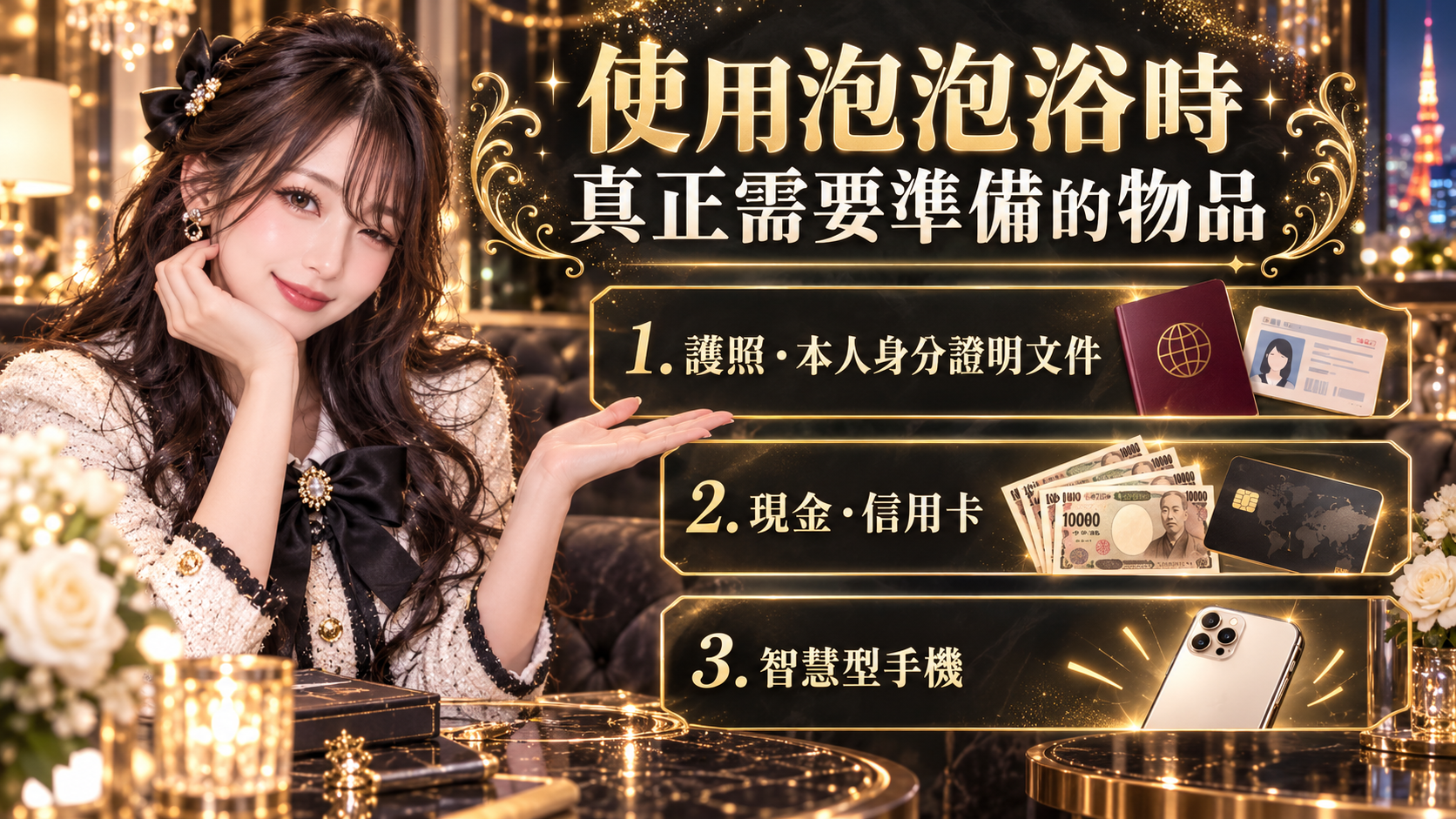
1. Passport and personal identification documents
Let’s clear up a common misconception right away:
A passport is not a “mandatory entry requirement” at Soapland—many official websites may not even mention this.
However, for general short-term visitors to Japan, you should always carry your passport with you.
According to Article 23 of the Immigration Control Act, as explained by Japan’s Immigration Services Agency, foreigners residing in Japan are generally required to carry their passport or corresponding authorization documents and present them upon request by authorized authorities; however, mid- to long-term residents who carry a Residence Card in accordance with the law are not subject to the same passport-carrying obligation.
Therefore, for foreign tourists visiting Japan for general sightseeing:
Carrying the original passport at all times is the traveler’s basic responsibility.
It is not recommended to use the following as substitutes:
-
A photo of the passport on a mobile phone
-
A photo of the passport on a smartphone
-
A PDF stored in the cloud
-
"I remember the number," so it’s okay not to bring it
This is because there is no uniform standard regarding whether individual stores will accept these items.
Additionally, the current Service Guide for Adult Foreign Visitors to Japan notes that businesses may request to see a passport or other form of identification to verify age.
Therefore, the most accurate guideline is:
Foreign travelers should carry a valid passport with them at all times; whether a business requires presentation of identification and which forms of ID are accepted depends on each establishment’s policies.
2. Cash and Credit Cards
If you’re already accustomed to using the following combination while traveling in Japan:
Suica + Apple Pay + credit card
and moving through everything seamlessly without cash, it’s best to set that routine aside for a bit when visiting adult entertainment establishments.
The latest 2026 Soapland Guide still clearly states:
Cash is the primary payment method at many establishments.
Some establishments accept credit cards or other mobile payment methods, but others still do not accept them at all.
JNC Expert Tip:
-
At brick-and-mortar establishments, payment is typically required at the counter
-
Some stores accept credit cards, while others do not accept them at all
-
Some credit cards issued overseas may not be accepted
-
If you’re unsure about a specific business’s payment options, feel free to ask in advance
Therefore, for international travelers, the safest approach is to:
Have both sufficient cash in Japanese yen and a credit card accepted by the establishment on hand.
*Tip 1: Many travelers to Japan ask, “Isn’t JCB accepted at every store in Japan?
” While JCB is convenient at many stores in Japan, the adult entertainment industry is a special category. To save you valuable time and ensure a stress-free experience, we recommend paying primarily with cash. If you have other credit cards, it’s a good idea to carry a few of them as well.
*Tip 2: Many first-time visitors to Soapland ask, “How much cash is enough?”
Usually, the “total price” will be confirmed with you at the time of booking, but there are instances where customers encounter Girls they like and wish to purchase additional services on the spot. We recommend carrying a few ten thousand yen on hand just in case (roughly 10,000–30,000 yen).
3. Smartphones
A smartphone is not a “mandatory item” for entering a Soapland establishment.
However, for international travelers—or rather, for modern people—it’s practically the most important tool.
A single smartphone can handle the following tasks simultaneously:
-
Google Maps
-
Checking a store’s address
-
Checking reservation messages
-
Multilingual chat
-
Translation
-
Contact the business
-
View Rates
-
Save Establishment Rules
Especially in some adult entertainment districts in Japan:
Just because “Google Maps says you’ve arrived” doesn’t mean you’ll actually see it with your own eyes.
Building signs, entrances, and meeting spots aren’t always as obvious as a convenience store.
This is when your cell phone becomes essential—you can use it to contact the third-party booking agent or the establishment to confirm the entrance again.
*Quick reminder: Just because you can bring your cell phone doesn’t mean you can take photos—these are two completely different things.
The current FAQ for foreigners visiting Japan clearly warns about photography: even if certain establishments offer photography-related services, you still need the consent of both the establishment and the woman herself; unauthorized photography is unacceptable.
So, at the Soapland venue:
Cell phone = navigation and translation tool
Not:
Cell Phone = A tool for taking casual photos.
If you need to take out your phone to use a translation app after entering the establishment, you can ask first:
“Can I
use a translation app?”
This will help avoid any misunderstandings with the shop staff or the Girls!!
Other recommended items that “come in handy” when taking Soapland
* Translation app
If your Japanese proficiency is at the level where:
“I can order food, but I can’t understand the staff’s subsequent explanations,”
then a translation app will be extremely useful.
A recent guide for foreign tourists visiting Japan also recommends using a translation app at establishments with limited foreign language support.
We recommend downloading and familiarizing yourself with the following apps first:
-
Google Translate
-
DeepL
-
Apple Translate
-
Other translation tools you’re familiar with
The point isn't really which AI produces the most polished translations.
Rather:
Don’t wait until you’re inside the store to figure out where the buttons are for the first time—it’ll just make both you and the other person nervous.
-
I recommend saving a few Japanese phrases on your phone
予約しています。
I have a reservation.
“I’m a foreigner—is that okay?
”
“Can I pay by card?”
"How much is the total?
"
Is it okay if I
use a translation app?
These five phrases are way more useful than memorizing “You look beautiful tonight” before you leave.
You can learn about romance later—it’s more important to settle the bill and get into the restaurant first!
* Power Bank
Power banks aren’t required by the restaurant, of course.
But it’s a classic example of:
“something you only realize is super important when you’ve forgotten it.”
Imagine this:
You spend the morning at Tsukiji
↓
and the afternoon in Shibuya
↓
,
↓
taking 200 photos
↓
with Google Maps, and by evening, your battery is down to 9% as you
↓
head to a Japanese address you’ve never been to before.
And then you still need to:
navigation + translation + access to your reservation records.
At this point, a power bank isn’t just an accessory. It’s a lifesaver!!!
So if your adult entertainment plans are scheduled for the end of a full day of travel, make sure to save your phone’s battery.
* Personal grooming items
Just because Japanese Soaplands have a shower doesn’t mean:
“I’ll be taking a shower anyway, so it doesn’t matter how I look right now.”
Basic manners are still basic manners.
You might want to bring:
-
Mint candies or breath fresheners
-
A small comb or dry shampoo
-
Antiperspirant or wet wipes
-
Simple personal care items you’re used to
Especially during the Japanese summer:
35°C + urban humidity + a 20-minute walk
That’s enough to turn anyone from “looking sharp before heading out” into:
“Did you just run a marathon?”
So, it’s a good idea to freshen up a bit to ensure a comfortable start for both you and the other person.
Items to Avoid Bringing and Precautions
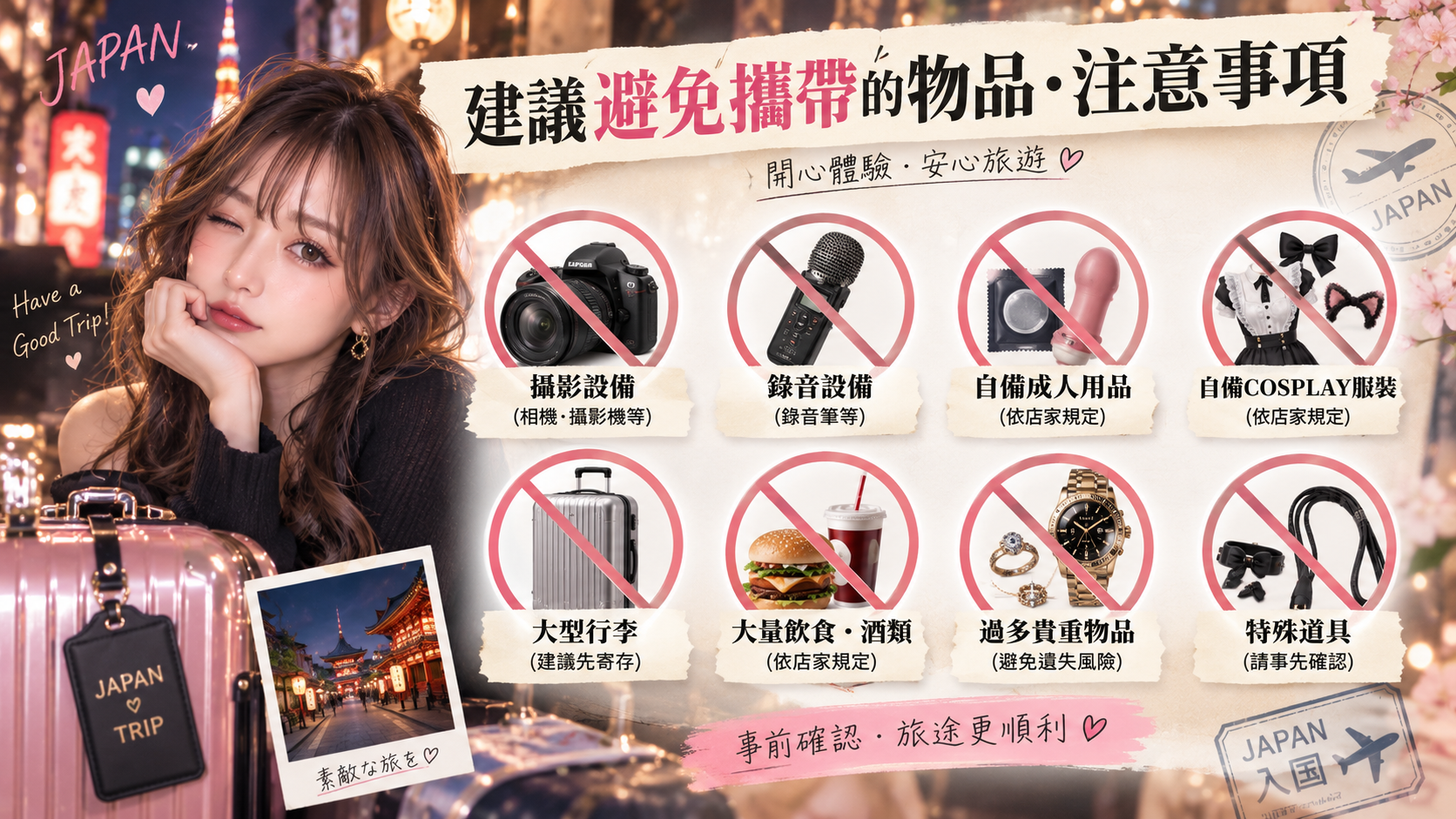
* Large luggage
This isn’t a “ban.”
It’s just: a hassle.
We also strongly recommend that you do not take a shower
on your last day before returning home. Imagine dragging:
-
a 29-inch suitcase
-
three bags of cosmetics and toiletries
-
one bag from Don Quijote
-
a backpack
and all sorts of bags and packages as you walk into the store—the whole experience can easily turn into: “Excuse me, where should I put all this?”
Storage space varies by store.
So if possible, please avoid making reservations on your last day if you don’t have luggage storage or are short on time.
If you really need to bring a suitcase, please use:
-
hotel luggage storage
-
Coin Lockers
-
Shops offering luggage storage services
It’s much more comfortable to travel with just a small backpack!
*Too many valuables and souvenirs
Make sure to bring enough cash to cover your expenses, but there’s no need to carry your entire travel budget with you.
It’s also not recommended to bring:
-
Expensive jewelry
-
Expensive watches
-
Large amounts of cash—three to four times the total cost of the trip or more
Why? The reason is simple: the fewer items you carry, the fewer times you’ll experience that
“Wait a minute, do I still have my stuff?”
In addition, many foreign tourists, whether out of a sense of politeness or a desire to curry favor with shop owners and Girls,
they often bring snacks or other small gifts. However, it’s not recommended because many shopkeepers and staff will refuse food of unknown origin on the spot.
Or, if a Girl receives a gift but has safety or hygiene concerns, she may simply throw it away after you leave. Therefore, unless you’re a frequent customer or on friendly terms with the shop and staff, there’s no need to go out of your way to prepare a gift.
*Cameras and Recording Devices
Nowadays, many people carry photography equipment in their bags as a hobby or for their social media content creation
However! Unless you have prior consent, it is not recommended to bring professional photography equipment to the venue.
This includes:
-
Cameras
-
GoPro / Insta360 / DJI… etc.
-
Voice recorders / audio recording equipment
-
All types of tripods
Unless the venue has confirmed in advance that these items are permitted, it’s simplest to leave them at the hotel to avoid any misunderstandings.
* Personal adult products or cosplay costumes
We cannot simply say, “All of these are prohibited.”
This is because some venues actually do allow them.
It’s true that some establishments state on their official websites that guests are allowed to bring adult products or cosplay costumes.
However, for hygiene reasons, many places prohibit bringing them in, while others only accept brand-new, unopened, and unused items. Therefore, it’s essential to confirm in advance.
So the general rule for these items is:
Ask first, then bring them.
You can ask:
“持ち込みできますか?”
“Can I bring my own?”
Don’t show up at the venue and pull something out of thin air like a magician:
“Ta-da! I brought this today.”
The shop owner might not be surprised at all.
Three key points to check before arriving at the store
① Identification documents:
Short-term visitors to Japan: Please bring your original, valid passport.
This is a requirement under Japan’s Immigration Control Act.
For those residing in Japan on a medium- to long-term basis, there is a legal obligation to carry a Residence Card; if you have your Residence Card with you, you are not required to carry your passport as well.
As for how the establishment verifies your identity, please refer to its specific policies.
We recommend using the same English transliteration as on your passport when making a reservation.
② Payment Methods
As we have repeatedly emphasized above and in numerous other articles, the majority of establishments still primarily accept cash for payment.
Therefore:
“I don’t have cash, but I have Apple Pay on my phone.”
is not an experiment you should try out on the spot.
Please make sure to find out the total amount in advance and carry cash exceeding the total by 10,000–50,000 (JPY).
③ Do They Accept Foreign Tourists?
You absolutely must not guess about this.
Japanese adult shops are not:
“Having a translation website = open to any Foreigner.”
If you’re unsure how to choose, all the establishments listed on our platform welcome foreign visitors; however, the languages supported vary by store. If you’re unsure how to make a reservation, please feel free to contact JNC
Also note:
"Foreigners Welcome" ≠ "Chinese Spoken."
“Being able to accommodate you” and “having someone who can speak Chinese with you the entire time” are two completely different experiences. So when booking a Girl, be sure to review the details carefully—don’t set your expectations for conversation too high, as this can lead to disappointment.
Checklist for International Travelers’ Personal Belongings

It’s best to take a screenshot of this section and save it.
✅ Be sure to check the following before heading out
-
□ Original passport / valid legal identification
-
□ Sufficient cash in Japanese yen
-
□ Cell phone is fully charged and a portable charger is on hand
-
□ Store name and address
-
□ Appointment time
-
□ Reservation confirmation message
✅ Highly recommended to bring
-
□ Credit cards accepted by the store
-
□ Translation app
-
□ Power bank
-
□ Mint candies / breath fresheners
-
□ Basic toiletries
-
□ Small carry-on bag
⚠️ Do not assume you can bring something without confirming first
-
Camera equipment
-
Recording equipment
-
Personal adult products
-
Bring your own cosplay costumes
-
Large quantities of food, drinks, or alcohol
-
Special props
Please check each store’s rules in advance regarding bringing your own adult products and costumes.
Summary
So, what should foreign travelers bring when visiting Japan to enjoy Soapland?
Passport, cash, and a cell phone—just remember these three items for now.
Short-term visitors to Japan are required by law to carry their passports; establishments may also ask to see identification to verify age or identity.
As for payment, many soaplands in Japan still primarily accept cash; whether credit cards and other cashless payment methods are accepted varies by establishment, so preparing cash in yen in advance is still the safest approach.
As for toiletries, there’s no need to worry too much.
Items such as towels, shampoo, conditioner, body soap, and hair dryers are usually provided by the establishment.
Ask yourself these five questions:
Do you have your ID? Do you have enough cash? Is your phone charged? Does the establishment accept Foreigners? Have you double-checked your reservation details?
Once you’ve confirmed all five of these points, you can actually travel light.
It’s natural to feel a little nervous when visiting an unfamiliar Japanese establishment for the first time.
But much of the anxiety about “what if something goes wrong” isn’t solved by packing ten extra items.
Instead, it comes down to:
spending an extra five minutes double-checking before you leave.
You don’t need to bring a bath towel.
Just don’t forget your passport.
Fu-ZoKlook x JNC Official LINE & Major Social Media Platforms
If you have any questions about Japanese adult entertainment or making reservations, or if you’d like to consult with us,
feel free to click the image below to join our official LINE account. JNC will provide free consultation services for everyone ♥
We’ll continue to update with more information and content related to Japan’s adult entertainment scene, so please stay tuned and keep supporting us, fellow enthusiasts!
You can also follow our social media accounts to stay up-to-date on the latest Japanese adult entertainment news 👇
👉Fu-ZoKlook x JNC on Major Social Media Platforms